3PL vs 4PL vs LaaS: What Changes as Logistics Matures

February 24, 2026 | By Jabil Procurement & Supply Chain Team
Logistics models rarely break overnight. They’re quietly outgrown, until total costs rise, service levels slip, and disruptions take longer to absorb than the business can afford.
Too often, these pressures are addressed in isolation, changing providers to chase lower costs or tightening SLAs to fix service gaps, only to see improvements in one area create new problems elsewhere.
Growth, geographic expansion, and rising volatility often force organizations to re-examine logistics models that once worked well but no longer scale cleanly. In most cases, this reassessment isn’t about whether to outsource logistics, that decision has already been made. It’s about how logistics is outsourced, and where responsibility, decision-making, and accountability should sit between the business and its partners.
That’s why the real issue isn’t choosing between 3PL, 4PL, or Logistics-as-a-Service (LaaS) as categories. It’s deciding how much ownership, intelligence, and accountability the business needs from its logistics operating model. Some organizations need execution. Others need coordination. Increasingly, many need orchestration across the entire network. In simple terms, 3PLs move freight, 4PLs coordinate providers, and LaaS orchestrates networks.
As a leader in LaaS, Jabil Procurement and Supply Chain Services can help organizations operationalize orchestration at scale. What matters here is understanding the progression from execution to coordination to orchestration, and which model fits your network today.
How Jabil Procurement Supply Chain Services Differentiate: 3PL, 4PL, and LaaS
At face value, 3PL, 4PL, and LaaS can look like incremental variations. The real differentiation becomes clear when you look at how decisions are made, how visibility is created, and where accountability sits across the network. That operating-model difference is where Jabil Procurement & Supply Chain Services separates LaaS from traditional execution or coordination models.
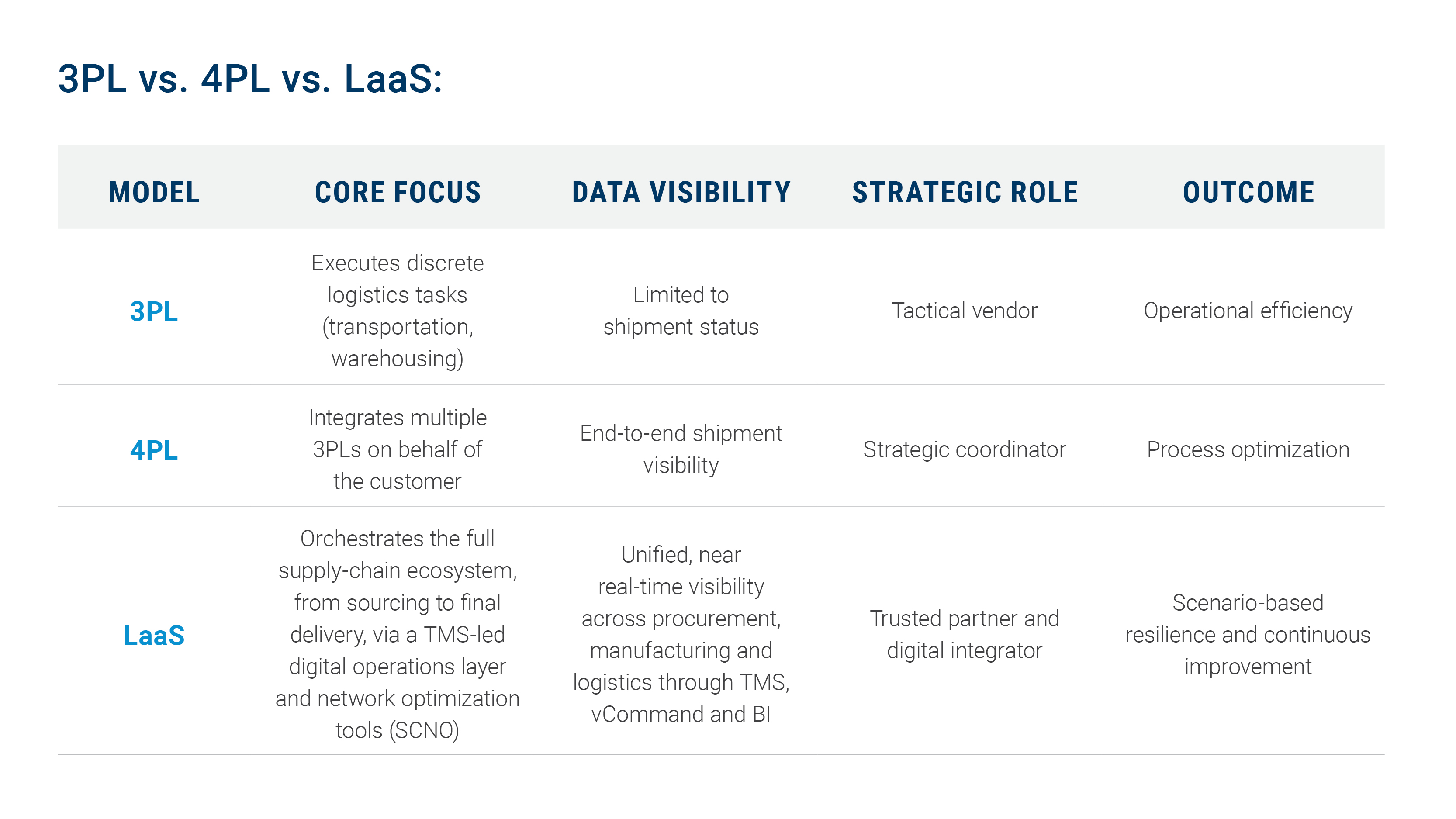
Seen this way, logistics maturity follows a clear progression. 3PLs focus on execution, handling discrete transportation and warehousing tasks with limited visibility beyond shipment status. 4PLs add coordination, integrating multiple providers and standardizing processes across the network. LaaS extends further, orchestrating the full supply chain ecosystem with unified, near real-time visibility and scenario-based decision-making.
Jabil’s LaaS model is designed for orchestrating the entire logistics ecosystem as a managed system, not just a collection of moves or vendors. By combining execution depth with a TMS-led digital operations layer, vCommand visibility, business intelligence, and supply chain network optimization (SCNO), Jabil enables unified, near real-time visibility across procurement, manufacturing, and logistics. Decisions are made at the network level, supported by scenario modeling and predefined response playbooks, rather than manual handoffs across silos.
The distinction between execution- and coordination-focused models and orchestration-led operating models matters more as volatility increases and the margin for error shrinks. Recent economic analysis suggests that more frequent supply shocks could reduce global GDP by roughly 5% and global trade by nearly 18% under localization-driven disruption scenarios. Orchestration-led models like Jabil’s LaaS are built for environments where faster, system-wide decisions determine cost, service, and resilience outcomes, and where logistics must keep pace with the business instead of reacting after the fact.
LaaS: Orchestration Model That Optimizes the Entire Network
Logistics-as-a-Service (LaaS) represents an orchestration-led operating model, combining execution, intelligence, and decision-making to optimize performance across the entire logistics network. Rather than focusing on individual moves or provider coordination alone, LaaS is designed to manage the system end to end, balancing cost, service, and risk in real time.

What Jabil’s LaaS Model Owns in Practice
Jabil’s LaaS operating model is defined by clear ownership and decision rights, supported by a TMS-led digital operations layer and network optimization capabilities:
- Unified, near real-time visibility across procurement, manufacturing, and logistics through TMS, vCommand, and Business Intelligence, not just shipment-level tracking
- Network-level exception management, where issues are resolved based on system-wide impact rather than escalated sequentially across vendors
- Scenario planning and what-if analysis using supply chain network optimization (SCNO) to test trade-offs before disruptions occur
- End-to-end performance optimization, balancing landed cost, inventory positioning, service levels, and risk across regions and providers
- Resilience playbooks, with predefined response paths for common disruption scenarios, enabling faster, repeatable decisions under pressure
When Jabil’s LaaS Becomes the Right Model
Jabil’s LaaS is designed for environments where coordination alone is no longer sufficient:
- Complex, multi-region networks where decisions in one area ripple across the system
- Persistent volatility across rates, lanes, demand, or geopolitical exposure
- A need to move from reactive firefighting to proactive, toward consistent, decision-led orchestration at scale
By design, Jabil’s LaaS shifts logistics from a set of coordinated activities into a continuously managed system. Decisions are made with full network context, not partial visibility, enabling faster response to disruption, lower variability, and more consistent service and cost performance across regions and partners. As networks scale and volatility becomes the norm, orchestration isn’t just an upgrade, it becomes the operating model that allows logistics to keep pace with the business.
How Jabil’s LaaS Model is Redefining Logistics Performance
The shift from 3PL to 4PL to LaaS isn’t just a change in scope, it’s a change in how logistics performance is created. Execution-focused models move freight, coordination models manage providers, and orchestration-led models manage the network as a system. What differentiates LaaS is not added responsibility, but faster, better-informed decisions made across the entire logistics ecosystem.
As complexity and volatility increase, performance increasingly depends on decision speed, visibility, and the ability to act before issues cascade. While execution and coordination models can work in stable environments, orchestration becomes essential when variability is constant and trade-offs must be evaluated in real time. That is where Jabil’s LaaS model redefines logistics performance, by aligning data, decision rights, and execution to keep the network moving in sync with the business.
Download the white paper to learn how Jabil’s LaaS approach improves decision speed, resilience, and end-to-end logistics performance.
Download NowPartnering with Jabil
Success in today’s logistics environment requires more than reliable execution, it requires orchestration. When logistics challenges are treated symptom by symptom, improvements in cost, service, or speed often come at the expense of the broader network. Jabil Procurement & Supply Chain Services takes a different approach, applying a Logistics-as-a-Service model designed to manage complexity holistically and continuously across the end-to-end network.
By partnering with Jabil Procurement & Supply Chain Services, organizations gain access to orchestration at scale, supported by a global footprint spanning 100+ locations across 30 countries and 38,000 supplier relationships. Combined with deep practitioner expertise, this model enables faster decisions, greater resilience, and sustained performance improvement as conditions change.
Leverage Jabil’s Logistics-as-a-Service capabilities to accelerate decision-making, strengthen resilience, and elevate logistics performance across your end-to-end supply chain.
Download the white paper to learn how Jabil’s LaaS approach improves decision speed, resilience, and end-to-end logistics performance.
Download Now