Building for What's Next at Procurement and Supply Chain LIVE London 2026

Procurement and supply chain leaders have spent years adapting to disruption. Now, the focus is shifting to what comes next. Organizations need the flexibility to respond as conditions change, rather than waiting for disruption to force action.
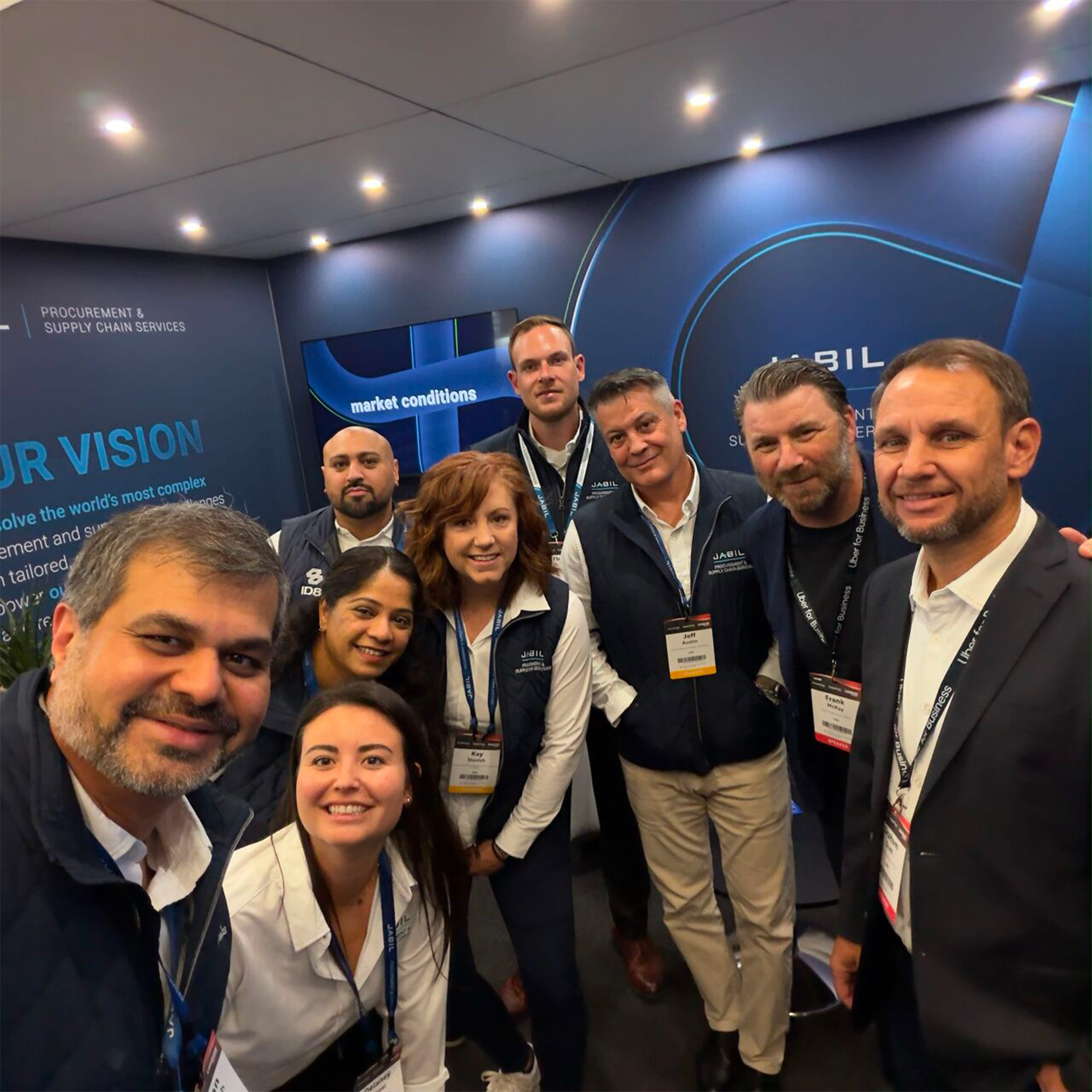
That challenge was a central theme of Jabil’s presence at Procurement & Supply Chain LIVE London 2026. The event brought together industry leaders to discuss the technologies, operating models, and strategies shaping the future of procurement and supply chain.
During the fireside session, “Built for What’s Next: Creating Optionality Across Procurement and Supply Chain,” Jabil Chief Supply Chain Officer Frank McKay and Chief Procurement Officer Graham Scott explored how organizations can create more flexibility across complex global operations.
Their discussion focused on a key principle. Optionality is not simply having more choices. It means building the supplier relationships, processes, technology, visibility, and expertise needed to make better decisions when conditions change.

Graham Scott, Chief Procurement Officer and Frank Mckay, Chief Supply Chain Officer, speak on stage at the London Summit.
Key Takeaways
- Build Optionality Early: Stronger supply chains create credible alternatives across suppliers, regions, and operating models before disruption makes them necessary.
- Strengthen Supplier Relationships: Scale creates more value when organizations understand critical dependencies and actively develop strategic supplier relationships.
- Balance Efficiency and Resilience: Cost remains important, but leaders also need to consider continuity, concentration risk, switching difficulty, and operational impact.
- Use AI to Accelerate Decisions: AI can help procurement teams evaluate large volumes of sourcing data faster, giving professionals more time to assess alternatives and trade-offs.
- Turn Visibility Into Action: Better data matters when teams have the expertise, processes, and decision-making structure needed to respond quickly as conditions change.
- Keep People at the Center: Jabil’s presence and recognition at Procurement & Supply Chain LIVE reinforced the role of experienced procurement, supply chain, and logistics professionals in navigating complexity.
Optionality Starts Before You Need It
Recent years have made supply chain volatility difficult to treat as an exception. Pandemic disruptions, semiconductor shortages, geopolitical uncertainty, and shifting customer requirements have reinforced the importance of having alternatives available before they are urgently needed.
Build flexibility at multiple levels
For supply chain organizations, that means developing contingency at multiple levels. Frank described an approach that considers:
- Local suppliers that can support individual markets
- Regional alternatives that provide another layer of flexibility
- Global partners that can expand the available response when conditions change
From the procurement perspective, Graham highlighted the value of understanding recurring market dynamics. Supply constraints may be difficult to predict precisely, but recognizing patterns, monitoring changes, and preparing alternatives can help teams respond earlier.
Together, these perspectives illustrate what practical optionality can look like. It does not require predicting every disruption. Instead, organizations can identify where they are most exposed and determine whether they have credible alternatives if circumstances change.
The earlier those questions are addressed, the more room teams have to make deliberate decisions rather than reactive ones.
Supplier Relationships Turn Scale Into Flexibility
A large supplier network can create opportunities, but scale alone does not guarantee flexibility.
Jabil works with approximately 38,000 suppliers across its global operations. Managing a network of that size requires more than transactions. It also requires understanding which relationships are most strategically important and developing them accordingly.
Relationships make alternatives actionable
Graham explained that Jabil introduced dedicated supplier relationship managers for approximately 100 suppliers considered vital to the company’s growth. The objective is to build stronger relationships that help both sides navigate complexity and respond to changing requirements.
This distinction becomes particularly important when markets tighten. Having another supplier listed in a database does not necessarily mean that supplier can provide the required capacity, quality, technology, or geographic support when demand changes.

Graham Scott, Chief Procurement Officer speaking on stage at the London Summit.
Organizations can strengthen optionality by asking:
- Where does viable alternative supply exist?
- Which supplier relationships require deeper development?
- Where is the organization overly dependent on one source, geography, or capability?
- How quickly could an alternative be activated if conditions changed?
Strong supplier relationships can therefore become a source of flexibility. When conditions shift, organizations with established alternatives and deeper supplier engagement may have more ways to respond.
Resilience Changes the Efficiency Equation
Optionality also introduces a more difficult question: How much flexibility is enough?
Procurement and supply chain teams face continued pressure to manage costs and improve efficiency. But an operating model optimized exclusively for efficiency can also remove the alternatives an organization may need during disruption.
The answer is not to create redundancy everywhere. Instead, organizations need to determine where additional flexibility creates meaningful business value.
Look beyond immediate cost
That can mean evaluating categories, suppliers, materials, geographies, and logistics networks against a broader set of considerations, including:
- Continuity and availability
- Lead times
- Supplier and geographic concentration
- Switching difficulty
- Market exposure
- Potential operational impact if supply is interrupted
This creates a different efficiency equation. Cost remains essential, but leaders also need to understand what they are giving up when they eliminate an alternative.
The goal is a more deliberate balance between efficiency and resilience, with flexibility concentrated where losing options would create the greatest operational consequences.
AI Can Help Teams Evaluate Options Faster
Building alternatives is only one part of optionality. Teams also need the ability to evaluate those alternatives quickly.
For organizations operating at global scale, the volume of information involved can make that difficult. Jabil, for example, re-quotes approximately 1 million part numbers each quarter.
Technology is helping compress that decision cycle.
Compressing the sourcing cycle
Within Jabil’s electronics sourcing operations, approximately 40 commodity managers oversee the sourcing of roughly 800,000 part numbers every 90 days.
Graham discussed how artificial intelligence (AI) integrated into Jabil’s sourcing platform has reduced work that previously required roughly three weeks within a sourcing cycle to approximately one day.
That acceleration changes what teams can do with their time.
Instead of devoting significant resources to manually processing information, procurement professionals can spend more time:
- Interpreting results
- Assessing alternatives
- Engaging suppliers
- Evaluating trade-offs
- Making strategic decisions
This also illustrates an important distinction in the role of AI. Technology does not eliminate the need for procurement or supply chain expertise. It can help professionals evaluate more information faster, while people remain responsible for understanding context, weighing trade-offs, and deciding how the organization should respond.
The combination of technology and expertise can ultimately expand optionality by making a larger set of alternatives practical to assess.
Visibility Has to Lead to Action
Better decisions also depend on better information.
Procurement and supply chain organizations often have data spread across enterprise resource planning systems, sourcing platforms, legacy technology, supplier systems, and other tools. Visibility becomes more useful when teams can connect that information and establish a reliable source of truth.
Frank emphasized the importance of bringing information together so professionals can access what they need and make faster, better-informed decisions.
Insight is only useful when teams can respond
Visibility alone does not create resilience.
Organizations still need processes for turning signals into action. Teams need clarity around:
- Ownership: Who makes the decision?
- Triggers: What thresholds require intervention?
- Alternatives: Which response options are available?
- Coordination: How will procurement, supply chain, operations, and other stakeholders work together?
People remain central to that model as well. As technology changes the way procurement and supply chain teams work, organizations need to continue developing the expertise required to interpret increasingly complex information and apply it to real operating decisions.
Data can reveal that conditions are changing. Optionality determines what an organization can do about it.
Celebrating Jabil’s People and Performance
Procurement & Supply Chain LIVE London also provided an opportunity to recognize the people and teams advancing the profession.
At the 2026 Global Awards, Jabil and its leaders earned recognition across procurement, supply chain, and logistics.
Recognizing leadership across Jabil
- Frank McKay, Chief Supply Chain Officer: Recipient of the Supply Chain Hero Award, celebrating his leadership and impact in navigating complexity and advancing global supply chain performance.
- Kurt Shafer, Senior Director, Procurement Services: Recipient of the Procurement Future Leader Award, recognizing his leadership, forward-thinking approach, and contributions to the future of procurement.
- Jabil | Global Trade & Logistics Award: Jabil received the award in recognition of the company's logistics capabilities and performance across complex global operations. Priya Anand, Director of Global Logistics Services, accepted the award on behalf of Jabil.

Together, these recognitions reflect the people behind Jabil’s procurement and supply chain capabilities and the collaboration required to operate across complex global markets.
They also reinforce an important theme from the event itself: Technology, data, and operating models continue to evolve, but people remain at the center of building stronger procurement and supply chain organizations.
Partnering with Jabil
For organizations building greater optionality across high-stakes, high-variability supply chains, repeatable performance requires more than point solutions; it requires an operating partner with proven scale, expertise, and the ability to turn insight into action. From targeted assessments and advisory to managed services, logistics execution, and data-informed market intelligence, Jabil helps leaders move from insight to execution across procurement and supply chain operations.
Jabil brings practitioner depth and global operating scale to help organizations execute with more resilience, control, and speed, without relying on one-off workarounds.
With 60+ years of supply chain expertise supporting 400+ leading brands, and backed by 100+ locations across 25+ countries and 38,000+ supplier relationships, plus $25B+ in annual procurement spend and 3,000+ supply chain experts, Jabil is built to deliver outcomes that hold up under volatility.