The Power Couple: Aligning Strategic Sourcing and Supply Chain Management

March 20, 2026 | By Jabil Procurement & Supply Chain Team
Key Points:
- Unit price rarely tells the truth: Freight variability, inventory buffers, and disruption recovery costs often determine whether a “low-cost” buy actually protects margin.
- TCO is the decision currency: Total Cost of Ownership ties supplier terms and sourcing choices to real-world cost-to-serve, service outcomes, and profitability.
- Build supply chain constraints into sourcing: Lane reliability, congestion, Incoterms, MOQs, and handling complexity shape execution costs long after the contract is signed.
- Supplier risk is operational and financial: Outage risk is driven by capacity, quality escapes, lane disruption history, and recovery speed alongside financial stability.
- Shared KPIs drive real alignment: When procurement and supply chain co-own the same metrics and data, trade-offs become explicit and decisions scale across categories.
Sourcing teams are often celebrated for “saving a nickel” on a part, only for Supply Chain to spend a dollar getting it where it needs to go. A contract can look great on paper, but once you factor in long lead times, unreliable lanes, premium freight, and excess safety stock, the economics quickly unravel.
Strategic sourcing focuses on who the business buys from and on what terms, with success measured in unit cost, negotiated savings, and contract compliance. Supply chain management is accountable for how those materials move through the network, with KPIs tied to service levels, lead times, inventory, and cost-to-serve. In many organizations, Strategic Sourcing and Supply Chain Management sit in different reporting lines, use different datasets, and are incentivized on different metrics, so friction is almost guaranteed.
That misalignment shows up as last-minute expedited shipments, warehouse congestion, unplanned inventory, and finger-pointing when margins erode. Both teams are working hard, but not always in the same direction.
When Strategic Sourcing and Supply Chain Management operate as a true “power couple,” the center of gravity shifts. Instead of optimizing contracts in isolation or firefighting logistics issues downstream, they jointly own outcomes like Total Cost of Ownership (TCO), resilience, and margin protection.
From Price to Total Cost of Ownership (TCO): The Bridge Between Sourcing and SCM
The price on the quote is the number everyone sees first. However, the Total Cost of Ownership (TCO) is the number that determines whether the decision actually creates value.
TCO gives Strategic Sourcing and Supply Chain Management a shared lens, connecting contract choices with the realities of how materials move, where they sit, and what happens when things go wrong.

What Total Cost of Ownership Really Includes
Rather than stopping at unit price, TCO pulls together the full economic picture:
- Direct spend: unit price, rebates, and payment terms.
- Logistics and transportation: lanes, modes, fuel surcharges, service fees, and expedited shipments.
- Inventory and working capital: safety stock, buffer inventory, and obsolescence.
- Quality and reliability: returns, rework, warranty claims, and downtime.
- Risk and disruption costs: lost revenue during outages, premium freight in a crisis, and the overhead of maintaining dual or multi-sourcing.
Why TCO Needs Both Strategic Sourcing and Supply Chain Management
Supply chain teams hold much of the operational data behind these cost buckets, while strategic sourcing controls the supplier and commercial levers that shape them. Neither side can see the true Total Cost of Ownership (TCO) alone:
- SCM: actual freight invoices, lead-time variability, inventory turns, and disruption history.
- Strategic sourcing: supplier mix, contract structures, volume and term commitments.
When those views stay separate, TCO becomes a theoretical concept instead of a decision tool. When they are combined, sourcing events, supplier awards, and contract terms are all tested against how the network actually runs, turning TCO into a practical way for both teams to co-own cost, risk, and service outcomes.
TCO in Practice: Global vs Regional Supplier
On paper, a global supplier with the lowest unit cost often looks irresistible. A regional supplier may quote a higher price, but ship through shorter, more reliable lanes with faster lead times and leaner inventory requirements. Once freight, working capital, and disruption risk are factored in, the regional option can deliver a lower TCO, and a far more resilient supply chain.
Beyond Price: How Strategic Sourcing and Supply Chain Management Should Design Decisions Together
“Lowest price” looks good in a spreadsheet, but it often hides the cost of complexity that Supply Chain must absorb later. When decisions are made on unit cost alone, they ignore the constraints, risks, and trade-offs that SCM manages every day, undermining both value and supply chain collaboration.

Strategic Sourcing vs Purchasing: Two Very Different Mandates
Although they’re sometimes used interchangeably, strategic sourcing vs purchasing reflects two very different scopes:
| Purchasing (transactional) | Strategic sourcing (long-term) |
|---|---|
| Focus on unit price and immediate needs. | Focus on TCO, supplier performance, and risk. |
| Short-term PO execution, approvals, and invoice matching. | Category strategies and multi-year supplier relationships. |
When these roles are blurred, decisions default to speed and unit price. When they are clearly differentiated and aligned with supply chain management, strategic sourcing designs the long-term playing field, suppliers, terms, and risk posture, while purchasing executes within that framework. That’s what keeps day-to-day buying activity consistent with TCO, resilience, and service goals, not just the cheapest line item.
The Hidden Constraints Only SCM Can See
Beneath every “cheap” quote is a network of real-world constraints that only Supply Chain sees clearly, including:
- Lane reliability and capacity.
- Port or border congestion.
- Minimum order quantities and packaging requirements.
- Incoterms and responsibility for duties, insurance, and freight.
- Warehouse and handling complexity that drives cost-to-serve.
When these factors are missing from the decision, a low unit price can lock the business into a high-cost, fragile network. Bringing SCM into the conversation early ensures those hidden constraints are designed into the sourcing strategy, not discovered after the contract is signed.
Scenario: Consolidation That Nearly Backfires
A global manufacturer moves to consolidate SKUs with a single low-cost supplier to unlock volume discounts. Before the award is finalized, SCM flags chronic port congestion and volatile transit times on the supplier’s primary lanes. Instead of abandoning the strategy, the teams redesign it, using the global supplier for base demand and adding a regional partner for surge and critical orders, preserving savings without sacrificing resilience.
Key takeaways:
- The real decision isn’t global vs regional, it is how to blend both to balance cost, risk, and service.
- When Strategic Sourcing and Supply Chain Management design the award together, volume leverage and operational reality can both be built into the strategy.
- “Lowest price” becomes one input into a broader lens of TCO, resilience, and service, rather than the default answer.
Joint Supplier Risk Mitigation: Using SCM Insights to Strengthen Strategic Sourcing
Supplier risk isn’t something procurement can manage from P&L statements alone. Effective supplier risk mitigation depends on Strategic Sourcing and Supply Chain Management seeing the same exposure and acting on it together. When one focuses only on contracts and the other only on day-to-day execution, issues surface late and are solved with expensive firefighting instead of deliberate design.

Two Sides of Supplier Risk: Commercial and Operational
Supplier risk is rarely one-dimensional. A supplier can look strong on paper from a commercial perspective while creating real exposure in the network, or the reverse. To make supplier risk mitigation effective, Strategic Sourcing and Supply Chain Management need to see both sides of the picture at once.
| Risk lens | What it covers | Typical indicators |
|---|---|---|
| Strategic sourcing view (commercial risk) | The supplier’s financial, contractual, cost, and ESG profile |
|
| SCM view (operational risk) | How the supplier performs in the real-world network |
|
Looked at in isolation, each lens is incomplete. Commercial risk tells you whether a contract is safe to sign; operational risk tells you whether that contract is safe to rely on. When Strategic Sourcing and Supply Chain Management combine these views, they can prioritize mitigation where it matters most, focusing dual sourcing, regionalization, and contingency plans on the suppliers and lanes that pose the greatest total risk to cost, service, and brand.
Designing Supplier Portfolios With Risk in Mind
When these perspectives are combined, supplier portfolios can be engineered deliberately rather than inherited by accident. Practical strategies include:
- Dual and multi-region sourcing for critical categories: Build at least one qualified alternate source in a different geography for high-impact components, so a disruption in one region does not halt production or force expensive last-minute switches.
- “Follow-the-sun” supply structures to spread time-zone and disruption risk: Design supply to span regions with complementary time zones and risk profiles, allowing production and support to continue when one region is offline due to weather, holidays, or geopolitical events.
- Tiered segmentation of suppliers with tailored risk strategies: Classify suppliers as strategic, preferred, or transactional and apply different risk treatments, such as deeper collaboration, joint contingency planning, or simple spot-buy flexibility, based on their role in the portfolio.
- Aligning risk appetite with product criticality and customer expectations: Accept more risk on non-critical, low-margin items, while tightening risk controls, redundancy, and service-level commitments for components and customers that directly affect revenue, safety, or brand promise.
Scenario: Electronics OEM Reducing Single-Supplier Risk
An electronics OEM sources a key component from a single Asian supplier with attractive pricing and strong quality metrics. Over time, SCM data reveals a pattern of port congestion and increasing transit time volatility on the main export lane. Rather than waiting for a major disruption, Strategic Sourcing and SCM jointly decide to qualify a nearshore second source. The unit price is slightly higher, but shorter lead times, lower logistics variability, and reduced outage risk drive a better overall TCO and a more reliable customer experience.
Key takeaways
- The real risk wasn’t the supplier’s price or quality; it was concentration on a single region and lane that kept failing the network.
- When Strategic Sourcing and Supply Chain Management act on shared data, they can introduce a second source before a crisis hits, instead of reacting after the fact.
- Paying slightly more per unit can still lower overall TCO when it reduces logistics volatility, outage risk, and the downstream cost of missed orders and recovery.
Shared Intelligence: Building a Common Data Backbone for Sourcing–SCM Collaboration
Shared intelligence is what turns ad hoc coordination into true supply chain collaboration. Instead of each team running its own reports and reacting in isolation, Strategic Sourcing and Supply Chain Management work from a continuous flow of shared data about cost, performance, and risk, and use it to make decisions together.

What Shared Intelligence Actually Looks Like
Shared intelligence is less about a single platform and more about how decisions are timed and tuned. When both sides see the same picture, they can:
- Re-time RFx events based on commodity cycles and freight markets, not just contract anniversaries.
- Adjust volumes across suppliers when logistics performance or capacity shifts.
- Renegotiate contracts based on real cost-to-serve, not just historic price benchmarks.
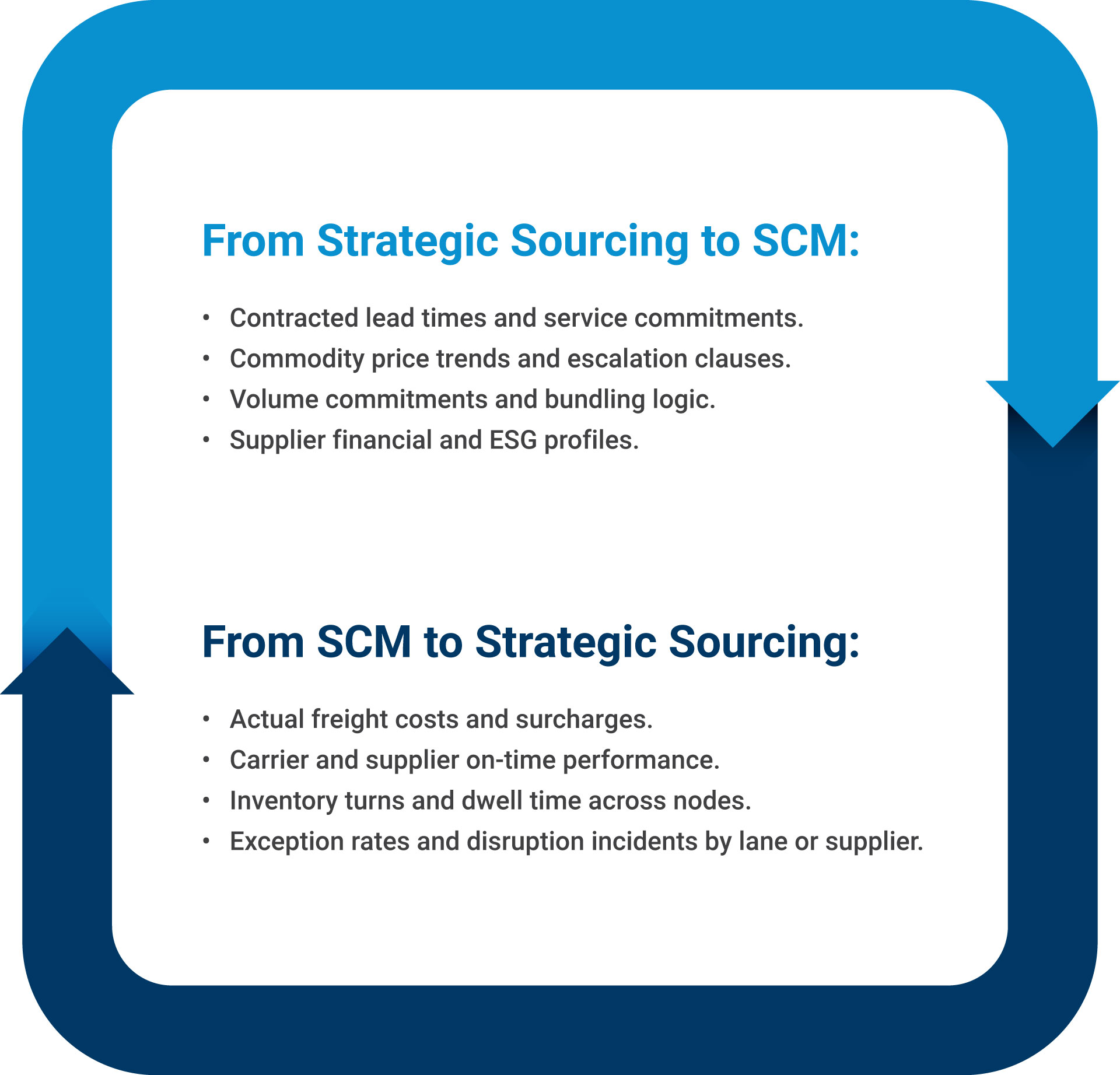
Key Data Flows in Both Directions
For shared intelligence to actually change decisions, data has to move in both directions, not sit in siloed reports. The foundation is a small set of reliable, always-on data flows between Strategic Sourcing and Supply Chain Management.
With these flows in place, sourcing can see where “good” contracts are creating poor cost-to-serve or service, and SCM can see which commercial levers, terms, volumes, supplier mix, are available to fix it. That shared backbone becomes the basis for re-timing RFx, reshaping supplier portfolios, and renegotiating based on actual TCO and risk, not just last year’s assumptions.
Enablers Without the Buzzwords
The technology doesn’t need to be glamorous; it needs to be useful. Shared dashboards, integrated procurement-and-logistics data, and digital twin or vCommand-style visibility all serve the same purpose: giving practitioners a single, trusted view of how sourcing choices play out in the network, so every decision can be tested against TCO, risk, and service before it is locked in.
The Power Couple Model: Strategic Sourcing and Supply Chain Management as Co-Owners of Outcomes
Strategic Sourcing and Supply Chain Management are at their best when they stop working in sequence and start sharing ownership. Instead of optimizing separate scorecards, they align around the same economics, risk view, data, and success metrics so every decision supports the end-to-end value chain, not just a single function.
Four Pillars of the Power Couple Model
At its core, the model rests on four pillars:
- Shared Economics: Joint TCO ownership, including cost-to-serve, landed cost, and inventory.
- Shared Risk View: Joint disruption and supplier risk mapping, plus aligned decisions on dual sourcing and regionalization.
- Shared Intelligence: Integrated data and analytics, shared dashboards, and a single version of the truth.
- Shared KPIs: Common metrics, OTIF, margin, working capital, ESG performance, built into both teams’ scorecards.
Together, these pillars turn Strategic Sourcing and Supply Chain Management from adjacent functions into a single decision-making system that steers cost, risk, and service in the same direction.
Maturity Stages: From Siloed to Embedded
Organizations typically progress through three stages:
- Stage 1: Siloed and reactive: Decisions made in isolation, frequent firefighting and expedites.
- Stage 2: Project-based collaboration: Teams align for major RFPs, crises, or transformation programs.
- Stage 3: Embedded co-ownership: Joint governance over categories, suppliers, and TCO is the norm.
Understanding where you are on this curve makes it easier to set realistic next steps—shifting from ad hoc collaboration to a repeatable model of shared ownership over suppliers, categories, and outcomes.
What Changes When the Model Is in Place
When the power couple model is active, the impact shows up quickly:
- Lower TCO with fewer unpleasant surprises.
- Better service and fewer expedites.
- Faster recovery from shocks and disruptions.
- Stronger ESG performance without runaway cost.
In practice, that means fewer surprises for finance, fewer crises for operations, and more headroom for the business to grow without constantly rebuilding the supply base. End-to-end procurement and supply chain partners like Jabil PSCS can help organizations move from Stage 1 to Stage 3 faster by combining practitioner experience, data, and tooling to operationalize this model across categories and regions.
Partnering with Jabil
For organizations working to align Strategic Sourcing and Supply Chain Management, repeatable performance requires more than isolated cost initiatives, it requires an operating partner that can help teams co-own Total Cost of Ownership, supplier risk, and service outcomes across the end-to-end network.
Jabil brings 50+ years of practitioner experience managing complex global supply chains for 400+ leading brands, supported by 100+ locations across 25+ countries and 38,000+ supplier relationships.
From targeted advisory and assessments to managed services, logistics execution, and data-informed market intelligence, we help leaders move from insight to execution across strategic sourcing, supplier portfolio design, risk mitigation, and end-to-end supply chain performance.
To explore how Jabil can help you standardize decision-making across suppliers, categories, and lanes, connect with our team.