Three Shifts Defining Procurement After PSC LIVE Chicago

May 29, 2026 | Jabil Procurement & Supply Chain Services
Procurement and supply chain leaders are entering a more practical phase of transformation.
That was one of the clearest themes our team heard at Procurement & Supply Chain LIVE Chicago. The conversation was less about what AI, resilience, and supplier visibility could mean in theory, and more about how to make those priorities work inside real organizations.
The throughline was execution: how teams adopt new tools, manage supplier risk, and make better decisions in more complex operating environments.
Here are three shifts our team heard at PSC LIVE Chicago that are defining where procurement and supply chain leadership is headed next.
Shift 1: Practitioner-Led Execution Is Becoming a Competitive Advantage
For years, procurement and supply chain transformation has been framed around technology: new platforms, dashboards, automation tools, and data capabilities designed to help teams work faster and smarter.
Those tools still matter. But what stood out at PSC LIVE Chicago was how much the conversation has shifted toward execution. Leaders are focused less on what to implement next and more on how experienced practitioners can help teams get measurable value from the systems, data, and processes already in place.
In practice, that means focusing on the areas where transformation often slows down:
- Turning existing tools into practical workflows
- Improving adoption across teams and stakeholders
- Connecting technology investments to measurable outcomes
- Balancing advanced AI capabilities with procurement and supply chain expertise
- Building smarter, more resilient solutions for customers
As Kurt Shafer, Jabil’s Senior Director of Global Procurement, explained:
“Through our joint venture with ID8 Global, we bring together the best of both worlds: our deep expertise in procurement and supply chain alongside advanced AI capabilities to build smarter, more resilient solutions for our customers.”
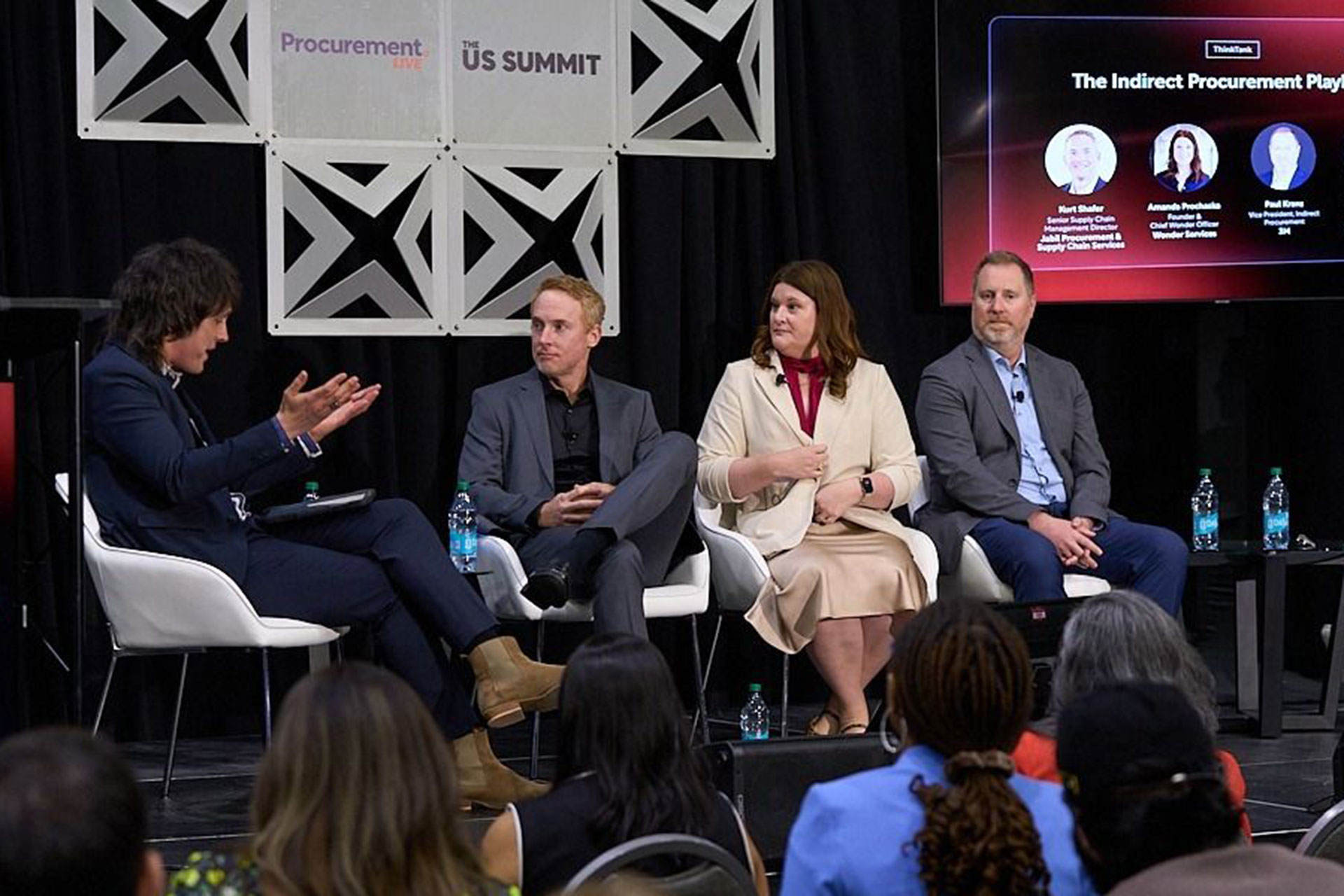
Kurt Shafer, Senior Director, Global Procurement, speaks on a panel at Procurement & Supply Chain LIVE.
Shift 2: AI Is Moving From Pilots to Practical Workflows
AI is no longer a future-tense conversation in procurement and supply chain. What stood out at PSC LIVE Chicago was how quickly the discussion has moved from what AI could eventually do to where it is already beginning to create value.
Teams are applying AI across contract lifecycle management, predictive risk sensing, tail spend, cost control, supplier resilience, analytics, and decision support. The next challenge is making sure those use cases move beyond isolated pilots and become part of how procurement teams actually operate.
For leaders, that means focusing on the conditions that turn AI into practical business value:
- Embedding AI into real workflows, not standalone experiments
- Using AI to simplify repetitive work and surface insights faster
- Improving data quality, governance, and user adoption
- Pairing automation with human judgment, supplier context, and business nuance
As AI scales, the organizations that benefit most will be the ones that understand where technology should accelerate work, where people should remain in control, and how both should operate together.
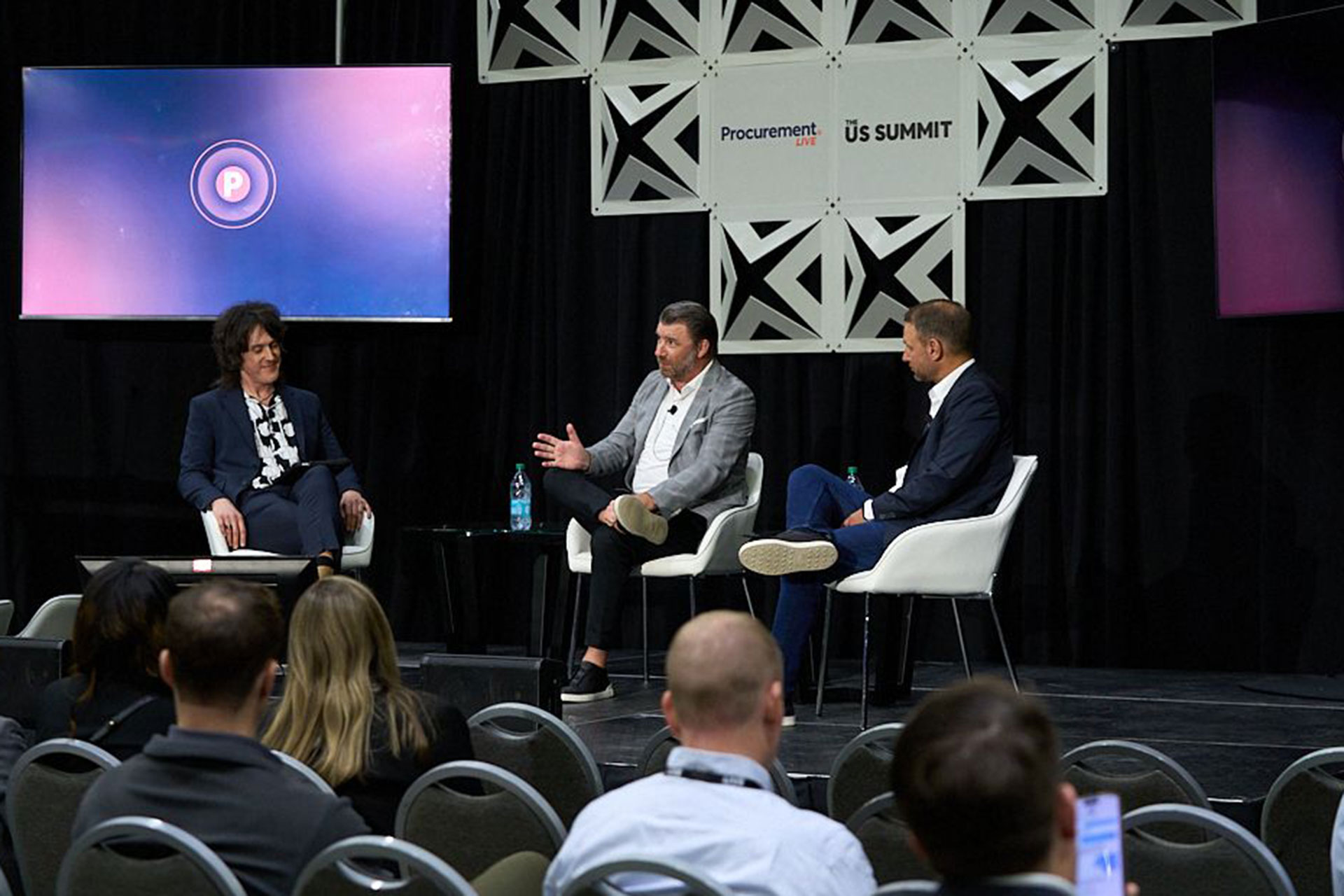
Frank Mckay, Chief Supply Chain Officer, and Graham Scott, Chief Procurement Officer, speak onstage at Procurement & Supply Chain LIVE.
Shift 3: Resilience Is Redefining Procurement Value
Efficiency and cost control still matter. But what stood out at PSC LIVE Chicago was how much procurement value is expanding beyond the traditional lowest-cost model.
Leaders are prioritizing resilience, visibility, agility, supplier risk management, and orchestration as they navigate a more complex operating environment. The shift from just-in-time to just-in-case is part of that change, pushing organizations to think differently about continuity, supplier readiness, and the ability to respond when conditions change.
For procurement leaders, that means building operating models that can balance cost with resilience:
- Improving visibility into supplier risk and performance
- Strengthening supplier strategies around continuity and optionality
- Connecting data, suppliers, decisions, and execution across the business
- Building more agile processes that support faster response
- Measuring procurement value through cost performance, risk management, and operational continuity
The strongest procurement organizations will still pursue savings and productivity. But they will do so within a broader value equation that includes resilience, responsiveness, supplier health, and the ability to keep the business moving.
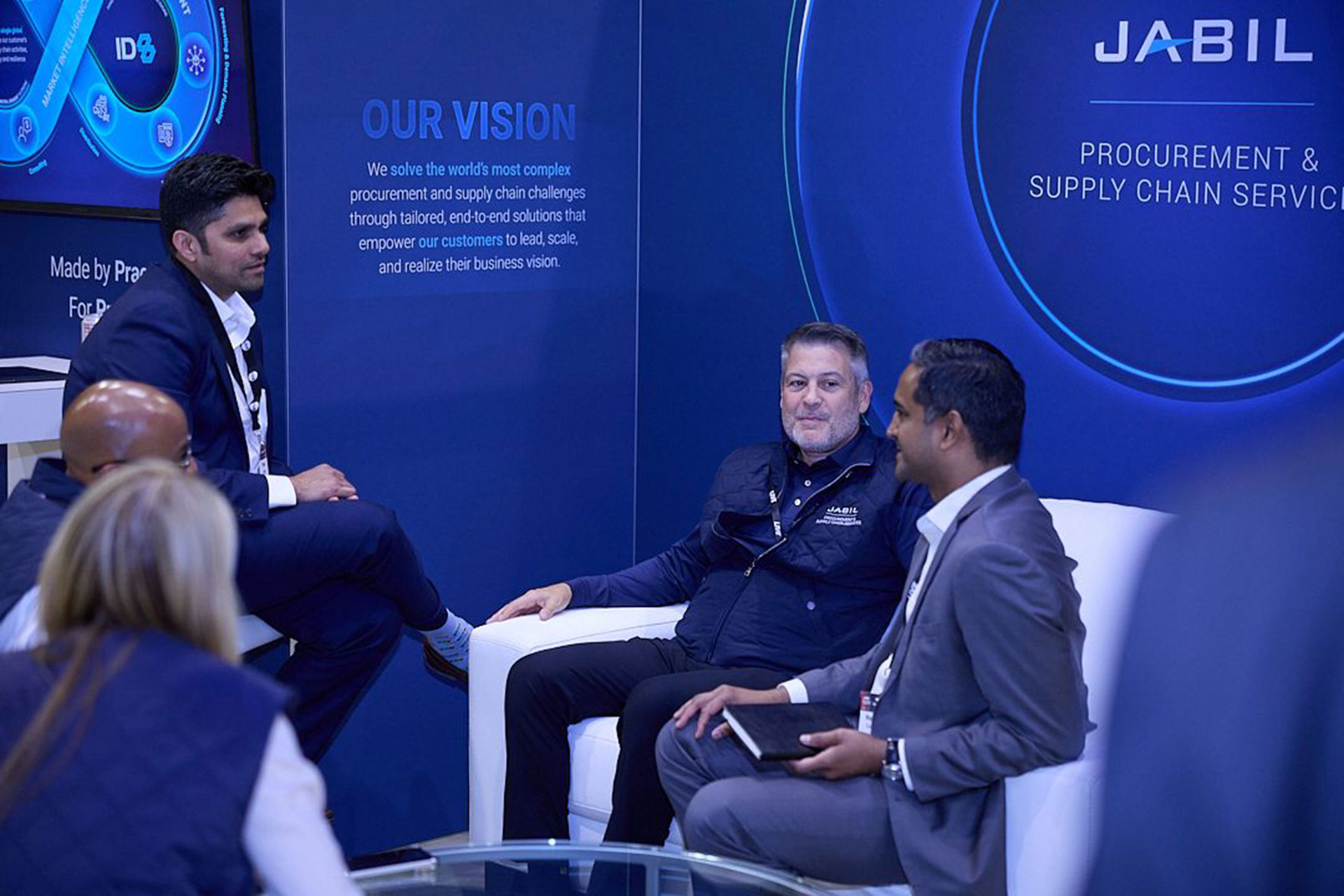
Jeff Austin, VP Procurement & Supply Chain Services, meets with customers at the Jabil Procurement & Supply Chain Services booth.
Procurement Is Becoming More Strategic and More Operational
Taken together, these shifts point to a broader change in procurement’s role.
The function is becoming more strategic, with greater influence over resilience, cost control, AI adoption, supplier performance, and business continuity.
At the same time, it is becoming more operational. Leaders need more than strategy decks or transformation roadmaps. They need teams that can adopt new tools, act on data, manage suppliers, and deliver measurable progress.
The next phase of transformation will be defined by action. Organizations need to simplify work, strengthen decision-making, improve visibility, and build operating models that can adapt as conditions change.
Partnered with ID8 Global, Jabil combines deep procurement and supply chain expertise with advanced AI capabilities to help organizations make that shift, moving beyond transformation talk and toward smarter, more resilient procurement and supply chain operations.
Partnering with Jabil
Complexity in procurement and supply chain isn’t slowing down, and execution is what separates strong strategies from real results. Jabil Procurement & Supply Chain Services helps organizations operationalize change through procurement and supply chain consulting, managed services, logistics management, and market intelligence, so performance improves in a way that’s repeatable, not reactive.
Jabil is a practitioner-led operating partner built to manage high-variability, high-stakes global supply chains, helping teams move from strategy to durable execution with confidence and consistency.
With 60+ years of supply chain expertise, $25B+ in annual procurement spend, 38,000+ supplier relationships, 3,000+ supply chain experts, and a global footprint spanning 100+ locations across 25+ countries, Jabil brings the scale and execution depth required to make improvements stick.