Transportation Disruptions Are Forcing Companies to Store More Inventory: But at What Cost?

April 23, 2026 | By Jabil Procurement & Supply Chain Services
Modern supply chains are long, thin and fragile, and increasingly susceptible to breakage. Transportation disruptions rarely start and stop as ‘only’ a transportation problem.
Whether the trigger is geopolitical conflict, severe weather, or a regional bottleneck, delays tend to spread beyond the lane where they began. Cargo gets rerouted, transit times stretch, and goods spend longer in motion or waiting at handoff points.
For supply chain leaders, the important question is what happens next.
As transportation becomes less predictable, inventory strategy needs to shift. Companies start ordering earlier, building more buffer stock, or repositioning goods closer to production and demand. While these moves can protect service and reduce disruption risk, they can also tie up large sums of cash in slow moving or stagnant inventory.
That is why transportation disruptions are no longer just a logistics problem. They are increasingly a working capital problem, turning inventory financing into a strategic lever.
Key Points
- Transportation impacts change inventory strategy: When transportation becomes less reliable, companies often order earlier, hold more buffer stock, or reposition goods closer to production and demand.
- Reliability matters more than speed: The biggest issue is not just longer transit times, but lower confidence in arrival timing, replenishment windows, and network flexibility.
- More inventory carries hidden costs: Extra stock can tie up working capital, slow the cash cycle, and increase exposure to storage, handling, insurance, and obsolescence costs.
- Not all inventory costs the same: Where inventory sits in the network and how it is funded or owned can change its cost profile significantly.
- Inventory financing supports targeted resilience: In-transit and stored inventory financing can help protect continuity without forcing the business to absorb the full cash burden upfront.
How Transportation Delays Affect Inventory Strategy
Transportation delays affect inventory strategy because they undermine reliability, not just speed. Once shipments become harder to predict, companies lose confidence in arrival timing, replenishment windows, and the network’s ability to absorb disruption.
The result is more than slower freight. It is higher cost, more operational complexity, and greater pressure to rethink how inventory is timed, positioned, and protected. Maritime disruption still matters because more than 80% of the volume of goods traded worldwide moves by sea, but the same inventory logic applies when delays hit air freight, trucking networks, or specialized cargo flows.
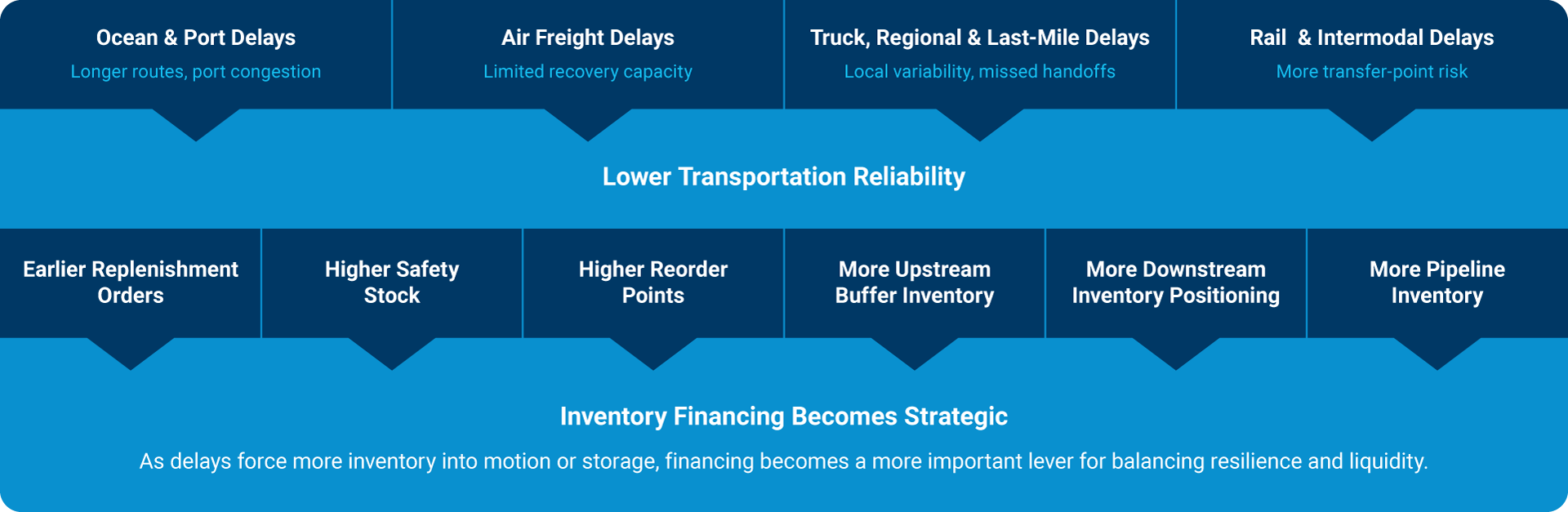
The pattern is straightforward. As transportation becomes less reliable, companies start protecting service with inventory. What changes is where that inventory sits, how early it has to be committed, and how much working capital it absorbs.
Ocean and Port Delays
When ocean routes lengthen or ports become congested, inbound timing becomes harder to trust. Companies often respond by ordering earlier, increasing upstream buffers, or staging critical materials closer to plants and distribution points so a delayed vessel does not become a production stoppage.
Inventory Financing in Practice:
When ocean variability forces earlier purchase orders or larger upstream buffers, inventory financing can help support those commitments without requiring the business to absorb the full cash burden upfront.
Air Freight and Expedited Shipment Delays
Air freight is often the recovery option for high-value, time-sensitive, or shortage-driven shipments. When that option becomes less reliable, more constrained, or too expensive to use repeatedly, companies often hold more safety stock for critical SKUs because the fastest path to replenishment can no longer be assumed.
Inventory Financing in Practice:
When premium freight stops being a dependable fallback, inventory financing can help protect critical supply by supporting more intentional buffer stock instead of repeated emergency buys.
Truck, Regional, and Last-Mile Delays
Ground delays affect factory handoffs, regional replenishment, and customer commitments even when international supply arrives on time. That often pushes inventory closer to production or end demand, with more stock held downstream to absorb local variability and protect service levels.
Inventory Financing in Practice:
When local or regional delays require inventory to sit closer to plants or customers, inventory financing can help support those downstream positions while preserving cash flow and service performance.
Rail and Intermodal Delays
Rail and intermodal delays create a different kind of uncertainty because they depend on multiple handoffs across terminals, carriers, and modes. The more transfer points involved, the greater the risk that inventory spends longer in motion, arrives out of sequence, or creates planning gaps that force businesses to add buffer elsewhere in the network.
Inventory Financing in Practice:
When inventory spends longer in transit because of transfer-point delays, inventory financing can help absorb that dwell time without turning resilience into a larger working capital drain.
The Hidden Costs of Storing More Inventory
Storing more inventory can feel like the safest response when transportation delays become harder to predict, but the real cost goes well beyond warehouse space. More inventory ties up capital longer, slows the cash cycle, and increases the cost of protecting continuity. That tradeoff matters at scale: U.S. business inventories reached $2.6807 trillion in December 2025, with an inventories-to-sales ratio of 1.36. Even small shifts in inventory posture can therefore have meaningful implications for liquidity, efficiency, and working capital performance.
That is one reason inventory productivity remains so closely watched, even as companies build more resilience into the network. U.S. wholesale inventories fell 0.5% in January 2026, and the inventory-to-sales ratio dropped to 1.25 from 1.33 a year earlier. The point is not that companies should avoid holding more stock, but that once inventory starts sitting longer, moving slower, or spreading across more nodes, leaders need a much clearer view of the full cost of that protection.
When companies store more inventory, the hidden costs usually show up in several layers at once:
- Working capital tied up: More inventory locks more cash into stock that has not yet been sold, consumed, or converted into revenue, increasing the opportunity cost of capital.
- Financing and interest expense: If inventory is funded through debt, credit lines, or other financing, carrying more stock can add interest and fee costs on top of the inventory purchase itself.
- Warehouse space and storage overhead: More inventory requires more room, whether through rent, owned space, overflow storage, or third-party warehousing. Utilities and facility overhead often rise with it.
- Handling and labor costs: Receiving, moving, counting, picking, and managing extra inventory all add labor and handling expense, even before goods are shipped onward.
- Insurance, taxes, and administrative costs: Higher inventory levels can increase insurance premiums, tax exposure, and the cost of managing inventory records, software, and controls.
- Security and shrinkage risk: The more inventory a business stores, the greater the exposure to theft, loss, and inventory shrinkage.
- Damage, spoilage, and deterioration: Some goods lose value simply by sitting longer, whether from handling damage, shelf-life limits, environmental exposure, or slow movement.
- Obsolescence and depreciation: Extra inventory increases the risk that products become outdated, less desirable, or worth less before they are sold or used.
Not All Delay-Driven Inventory Carries the Same Cost
Delay-driven inventory is often discussed as if it were one broad resilience decision: hold more stock, absorb the carrying cost, and move on. But in practice, the tradeoff is more specific than that. Where inventory sits and how it is owned can change the cost profile significantly.
The real cost depends on two factors, where inventory sits in the network and how it is funded or owned. A recent study found that only 20% of executives see building inventories as the best resilience strategy, while 42% favor diversification across suppliers and regions. The implication is not that inventory matters less. It is that inventory needs to be positioned more selectively and managed more deliberately.
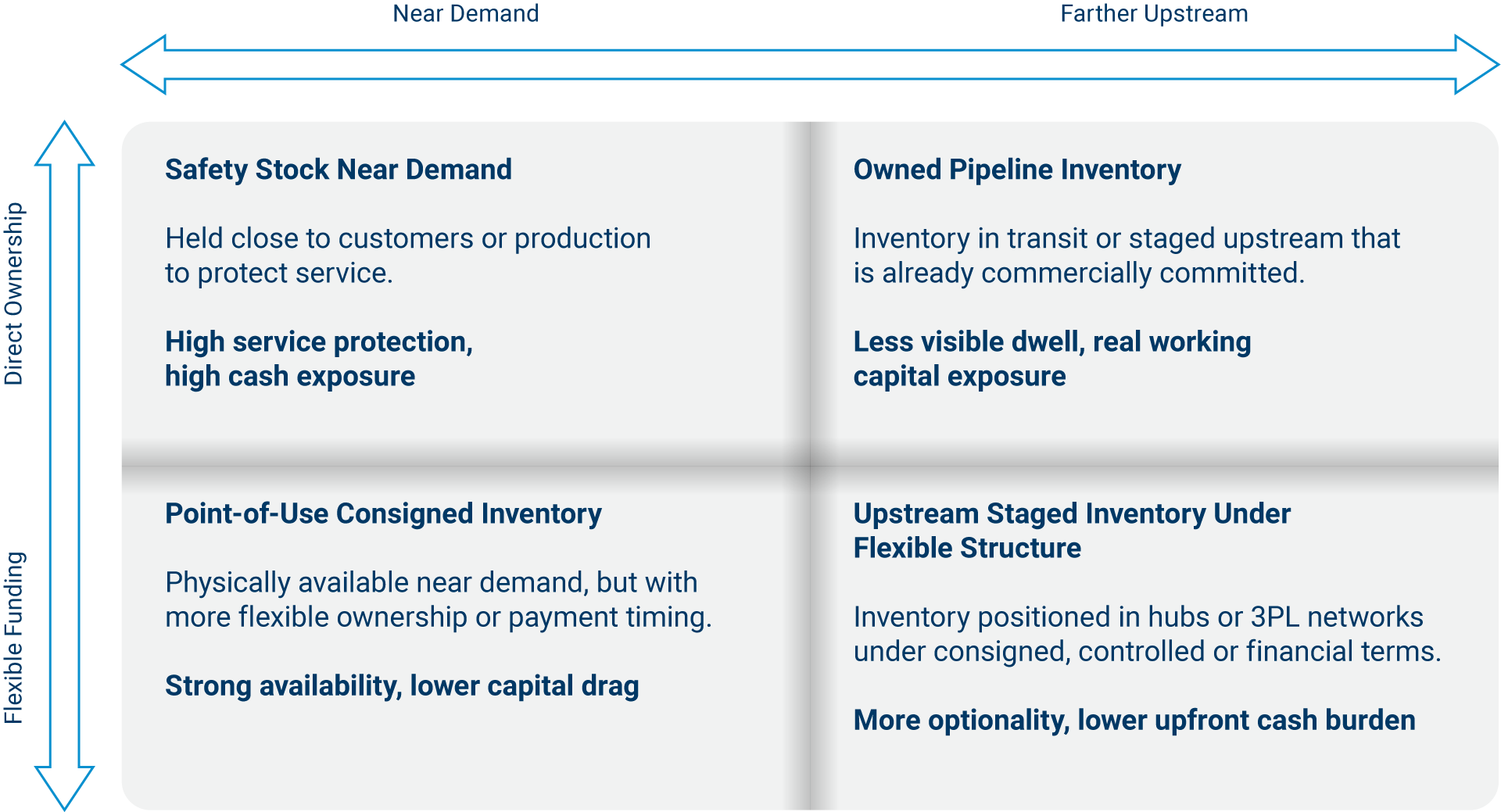
This framework shows why not all delay-driven inventory should be evaluated the same way. Inventory near demand can protect service but often carries higher cash exposure under direct ownership. Inventory positioned farther upstream or supported through more flexible funding can reduce capital drag, though with different tradeoffs in access and responsiveness. In a delay-prone environment, the cost of resilience depends as much on placement and ownership as on volume.
When In-Transit Inventory Financing and Stored Inventory Financing Make Sense
When delay-driven inventory becomes strategically necessary, the question is not whether to carry more stock. It is how to support that inventory without putting too much pressure on the balance sheet. That is where in-transit inventory financing and stored inventory financing become useful. Each addresses a different need based on where inventory sits and why it is being held.
In-Transit Inventory Financing
In-transit inventory financing is most useful when goods are already committed and moving through the network, but delays are extending how long they remain in motion. In these cases, the inventory is tied up operationally and financially before it can be used, sold, or converted into revenue.
| Scenario | Solution |
|---|---|
| A manufacturer is waiting on critical components moving through an ocean lane affected by repeated delays. The goods are already on the water, but longer transit times mean more working capital is tied up before production can move forward. | In-transit inventory financing helps bridge that gap by supporting inventory while it is still moving. This reduces the immediate cash burden of delays without leaving critical supply exposed. |
Stored Inventory Financing
Stored inventory financing makes sense when companies need to hold inventory in hubs, warehouses, or positions closer to production and demand to protect continuity. The inventory may be exactly where the business wants it operationally, but it can still create a cash burden if it sits too long or in too many places.
| Scenario | Solution |
|---|---|
| A company begins staging more inventory in regional warehouses because truck delays and inconsistent replenishment are making local availability more important. Service improves, but more cash is now tied up in stored inventory across the network. | Stored inventory financing helps support those positions more efficiently. It allows the business to hold targeted inventory where it matters most without absorbing the full working capital burden upfront. |
Why Visibility and Systems Alignment Matter
Neither model works well if teams cannot clearly track where inventory sits, how it is funded, and when ownership or risk transfers. The more delay-driven inventory a business carries, the more important it becomes to align logistics visibility, financial treatment, and system data.
| Scenario | Solution |
|---|---|
| A business adds financed inventory in transit and in storage, but procurement, logistics, and finance teams are not aligned on ownership timing or ERP treatment. Inventory is physically protected, but reporting and cash planning become harder to manage. | Clear visibility, defined ownership structures, and aligned system treatment help ensure inventory financing supports the business operationally and financially. That reduces complexity at the moment resilience matters most. |
What Supply Chain Leaders Should Evaluate Before Holding More Inventory
Holding more inventory can be the right response to transportation delays, but only when it solves a specific business problem. The goal is not to add more stock by default. It is to identify where extra inventory protects continuity, where it creates unnecessary capital drag, and where financing may help balance resilience with working capital discipline.
Before increasing inventory, supply chain leaders should ask:
- Which categories are most vulnerable to delay variability?
- Which delays create real service, revenue, or production risk?
- Is the bigger issue inventory that is stuck in transit or inventory that must be stored longer?
- Which inventory positions are worth financing because they protect uptime, customer service, or critical demand?
- Are logistics, finance, and ERP teams aligned on ownership, timing, and financial treatment?
The strongest inventory decisions are rarely about volume alone. They are about precision, knowing where added inventory truly reduces risk, where it creates avoidable cost, and how to support it in a way that protects both continuity and cash flow.
Partnering with Jabil on Inventory Financing Strategy
For organizations managing high-stakes, high-variability supply chains, repeatable performance requires more than point solutions. It requires an operating partner that can help balance transportation disruption, inventory availability, and working capital performance as conditions change.
Jabil brings 60+ years of practitioner experience managing complex global supply chains for 400+ leading brands, supported by 100+ locations across 25+ countries and 38,000+ supplier relationships.
From targeted advisory and assessments to managed services, logistics execution, and data-informed market intelligence, we help leaders move from insight to execution across inventory strategy, procurement, logistics, and broader supply chain operations.
To explore how Jabil can support a more resilient and capital-efficient inventory strategy, connect with our team.