Why Procurement Is Becoming a Higher-Value Human Function
October 23, 2026 | By Jabil Procurement & Supply Chain Team
Artificial intelligence is changing procurement, but perhaps not in the way the most common conversations suggest.
The more important question is what procurement professionals can do when technology gives them back time for judgment, strategy, and decision-making.
That distinction matters at the scale of modern electronics sourcing. At Jabil, teams quote approximately one million part numbers every quarter, creating a significant volume of information for commodity professionals to analyze and manage. AI-enabled tools are already helping teams identify patterns, process information more efficiently, and reduce manual work. In some areas, work that previously took several weeks can now be completed in a day.
That kind of efficiency is significant, but speed alone is not the end goal. The larger opportunity is to redirect procurement capacity toward the work that still depends heavily on experience, relationships, context, and judgment.
As technology handles more routine analysis, human expertise becomes more valuable in the moments that require judgment, context, and strategic choice.
Key Takeaways
- Create Capacity: AI can reduce repetitive analysis and accelerate routine workflows, giving procurement professionals more time for strategic work.
- Prioritize Human Judgment: Technology can surface information and patterns, but experience and business context remain essential for interpreting signals and determining the right response.
- Focus Expertise Where It Matters: Supplier strategy, risk decisions, negotiations, and cross-functional decisions continue to depend heavily on relationships, judgment, and organizational knowledge.
- Combine Human and AI Strengths: The strongest operating model uses technology for scale, speed, and analysis while procurement professionals focus on priorities, trade-offs, relationships, and decisions under uncertainty.
- Redesign the Work: Procurement leaders should look beyond individual AI use cases and consider how automation can reshape workflows, team capabilities, and where experienced professionals spend their time.
How AI Is Creating More Capacity for Strategic Procurement Work
Procurement teams manage enormous volumes of information before many decisions can even be made. Supplier data, inventory, orders, lead times, pricing, logistics, demand, and other inputs all contribute to the picture, and bringing that information together has traditionally required significant manual analysis.
AI-enabled tools can reduce some of that burden by helping teams process information more efficiently and move toward decisions faster. That can create capacity in several ways:
- Reducing repetitive analysis: Automating routine processing gives procurement professionals more time to focus on work that requires deeper expertise.
- Identifying patterns faster: AI can help surface relevant trends and signals across large volumes of information that would take considerably longer to review manually.
- Accelerating routine workflows: Work that previously required days or weeks of analysis can, in some cases, be completed much faster.
- Creating more time for strategic work: Capacity gained through automation can be redirected toward supplier strategy, risk management, negotiations, and customer requirements.
The bigger opportunity is not simply to complete the same procurement work faster. It is to reconsider where experienced professionals can create the most value by shifting more of their time toward decisions that depend on relationships, business context, and expertise.
The real measure of AI’s value in procurement is not how much work it automates, but how effectively the capacity it creates is reinvested in higher-value work.
Why Human Judgment Still Matters in AI-Enabled Procurement
Access to information has always been important in procurement, but information alone does not make a decision. Technology can help teams process large data sets, compare inputs, identify patterns, and bring potential issues to the surface. Those capabilities can improve visibility across the supply base, but they do not eliminate the need to interpret what that information means for the business.
A useful way to think about the shift is through the progression from information to action.
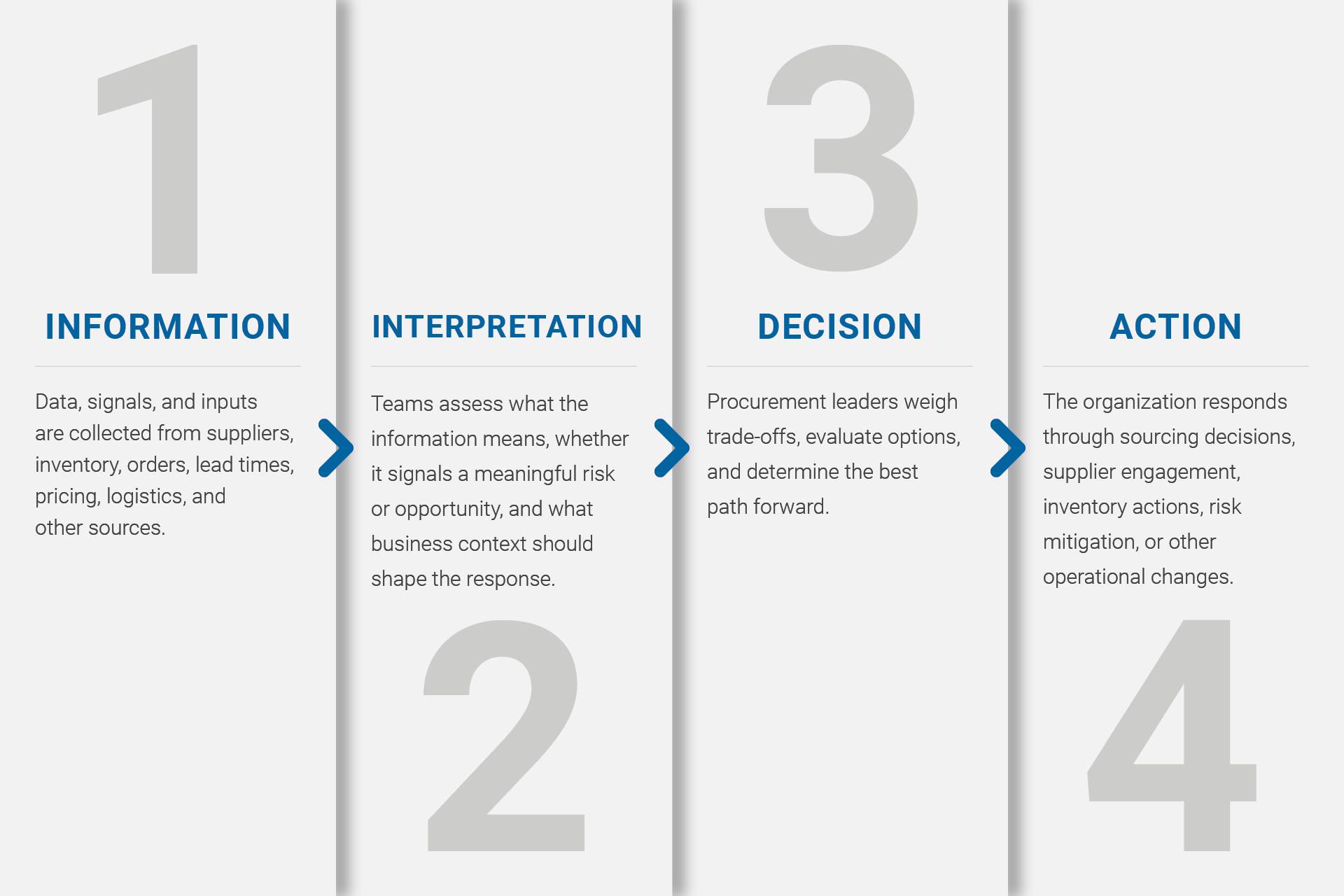
This is where human judgment becomes especially important. Identifying a signal is not the same as understanding its significance. A change in supplier performance, for example, may be easy to flag. Determining whether it creates a meaningful business risk, which programs could be affected, and whether action is required now or later is a more complex judgment.
The closer procurement gets to a consequential decision, the more important business context, experience, and judgment become. Technology can accelerate the flow of information and support interpretation, but human expertise is still what connects that information to the broader business and determines what should happen next.
The real advantage is no longer simply having more information. It is knowing which information matters, what it means, and how to act on it.
Where Human Expertise Adds the Most Value in Procurement
As routine analysis becomes easier to automate, several areas of procurement become even more dependent on human expertise. These are the areas where context, judgment, relationships, and experience continue to shape outcomes.
Supplier Strategy Decisions
Supplier information can be collected and analyzed more efficiently, but supplier strategy requires a longer view. Procurement teams need to understand where suppliers are investing, how their capabilities are evolving, and whether those developments align with future requirements.
Technology can make that information easier to access, but relationships and business context still shape the decision. A supplier may perform well today while becoming less aligned with future needs, whereas another may require development now to become strategically important later.
Best Practice: Evaluate suppliers based on both current performance and their ability to support future business requirements.
Procurement Risk Decisions
Procurement teams often need to act before every variable is known. A constrained component, changing supplier condition, or emerging risk can create several possible responses, each with different implications for cost, continuity, quality, and availability.
AI can help surface the relevant information, but it cannot remove the trade-offs. Experienced procurement professionals still need to assess consequences, weigh uncertainty, and determine which risks the organization is prepared to accept.
Best Practice: Use AI to strengthen risk visibility, then apply human judgment to weigh trade-offs and determine the appropriate response.
Supplier Negotiations
Better information can improve negotiation preparation, but it does not manage the relationship behind the conversation. Commercial negotiations still involve priorities, incentives, timing, leverage, trust, and the history of the supplier relationship.
Technology can strengthen the information available going into a negotiation, while human judgment determines how that information should be used and how immediate commercial goals should be balanced with long-term value.
Best Practice: Use technology to improve negotiation preparation while keeping relationship context, timing, and long-term value at the center of the conversation.
Cross-Functional Procurement Decisions
Procurement decisions rarely affect procurement alone. A sourcing choice can influence engineering, manufacturing, inventory, finance, logistics, or customer requirements, and an analytically attractive option may create technical or operational complications elsewhere.
That is where procurement professionals add value by connecting sourcing analysis to broader business realities and bringing the right functions into the decision before action is taken.
Best Practice: Bring the right functions into the decision early enough to evaluate technical, operational, commercial, and customer impacts before acting.
How AI and Human Expertise Work Together in Modern Procurement
The most productive way to think about AI in procurement is not as a choice between people and technology. It is a question of how each contributes to the work most effectively.
Some activities are increasingly well suited to automation, particularly those involving scale, speed, and repetitive analysis. Others still depend on human judgment, business context, and the ability to make decisions under uncertainty.
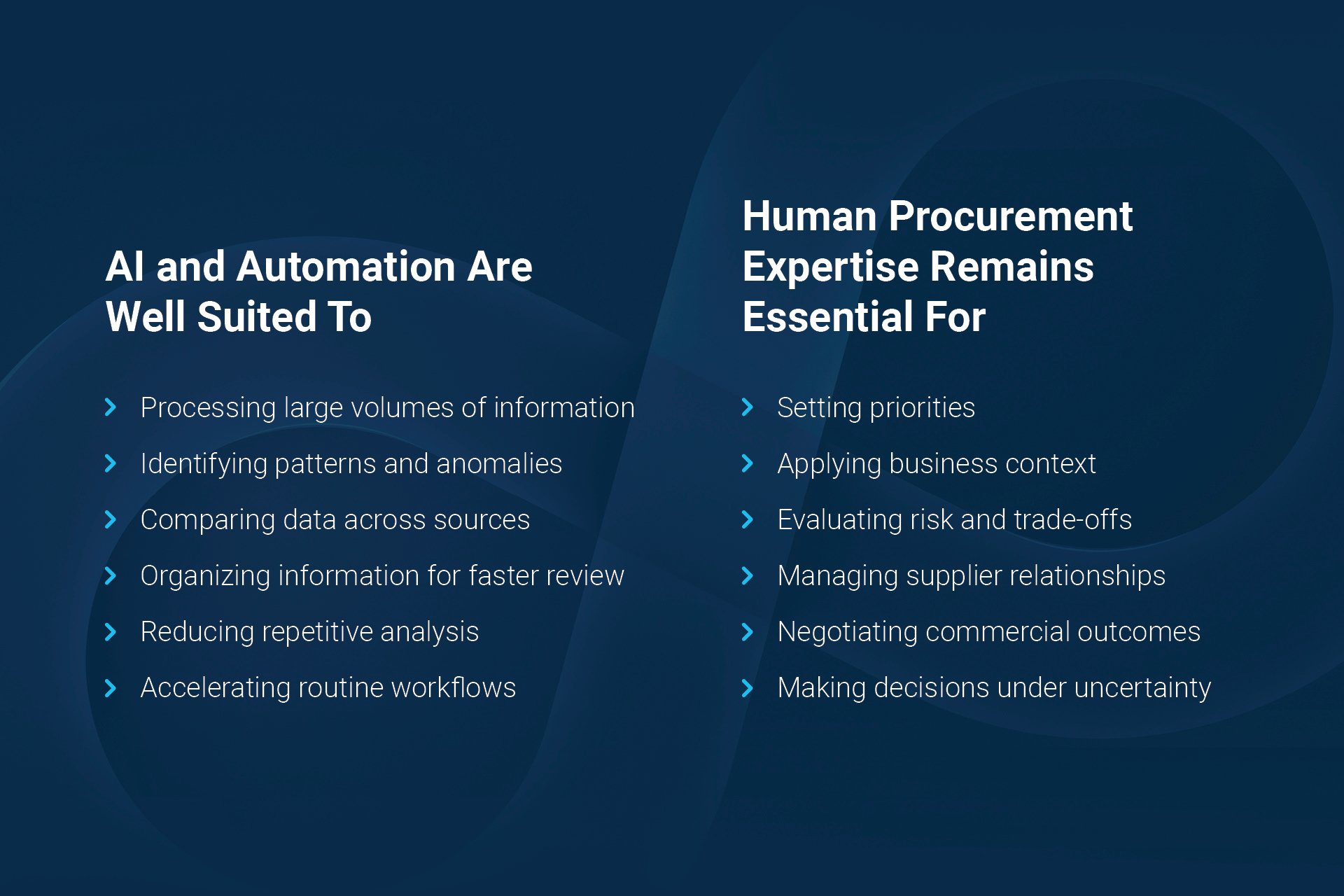
The value comes from combining those strengths deliberately. Technology can provide speed, scale, and analytical support, while procurement professionals determine priorities, weigh trade-offs, manage relationships, and remain accountable for the decisions that follow.
That requires more than adding AI to existing workflows. Leaders need to be clear about which parts of the procurement process benefit from automation and where human expertise should remain central.
The real opportunity is not to replace procurement judgment, but to apply it with better information, more context, and greater speed.
How Procurement Leaders Can Prepare Teams for More AI-Enabled Work
As AI takes on a larger share of routine analysis, procurement leaders need to look beyond individual tools and use cases. The more important question is how roles, workflows, and team capabilities should evolve alongside the technology.
That shift has implications for both operating models and talent. Leaders need to understand where expert time is being consumed today, which activities can be redesigned or automated, and which capabilities become more important as procurement professionals spend more time applying judgment and business context.
The foundation matters as well. AI-enabled procurement depends on connected, reliable information if teams are going to trust the insights it produces and act on them with confidence.
Questions Procurement Leaders Should Ask
- Which activities consume significant time without requiring significant judgment?
- Where could automation return meaningful capacity to the team?
- Which decisions depend heavily on experience, relationships, or business context?
- Do teams have the connected, reliable data required to use AI effectively?
- Are procurement professionals developing the strategic skills that become more important as routine analysis decreases?
The answers can reveal whether an organization is simply adding AI to existing processes or redesigning procurement around a new division of work between technology and people.
That distinction matters. Automating individual tasks may improve efficiency, but the larger opportunity is to reshape how procurement teams use their time, develop expertise, and contribute to business decisions. The greater opportunity comes when organizations treat AI not only as a productivity tool, but as a catalyst for elevating the role of procurement itself.
Partnering with Jabil
As technology reshapes procurement, organizations need more than new tools. They need the data, operating discipline, and practitioner expertise to turn faster analysis into better decisions. From targeted assessments and advisory to managed services, logistics execution, and data-informed market intelligence, Jabil helps leaders connect procurement insight with execution across complex supply chain operations.
Jabil brings practitioner depth and global operating scale to help organizations execute with more resilience, control, and speed, without relying on one-off workarounds.
With 60+ years of supply chain expertise supporting 400+ leading brands, and backed by 100+ locations across 25+ countries and 38,000+ supplier relationships, plus $25B+ in annual procurement spend and 3,000+ supply chain experts, Jabil is built to deliver outcomes that hold up under volatility.