Why Rising Fuel Costs Are Reshaping Inventory Financing

March 30, 2026 | By Jabil Procurement & Supply Chain Team
Fuel shocks rarely stay confined to freight costs. They move through the operating model quickly, raising landed cost, disrupting replenishment decisions, and putting new pressure on working capital. That leaves leadership teams asking sharper questions: Should we hold more inventory? Where should it sit? And how do we fund it without putting unnecessary strain on liquidity?
That progression feels especially relevant right now. Reuters reported on March 17, 2026 that Brent crude settled at $103.42 a barrel and that U.S. average diesel prices crossed $5 a gallon on March 16, 2026 for only the second time ever, reflecting how quickly energy shocks can move into the real economy.
For manufacturers, importers, and other complex supply chain operators, the bigger story is not simply that fuel is more expensive. It is that higher fuel costs change the economics of inventory strategy. As transportation becomes costlier and less predictable, companies are forced to rethink where inventory should be positioned, how often it should be replenished, how much buffer stock is needed, and what kind of financial structure can support those decisions.
That is where inventory financing becomes more important. In this environment, it is not just a treasury tool. It is a practical lever for resilience, margin protection, and working capital control.
Key Points
- Fuel volatility is changing more than freight costs: It is forcing companies to rethink how inventory should be positioned, funded, and protected.
- Inventory financing is becoming a strategic lever: It helps companies balance resilience with working capital discipline.
- The right structure creates more flexibility: Businesses can buy earlier, hold longer, and place inventory more deliberately without overloading the balance sheet.
- The real question is where volatility is changing behavior: For supply chain leaders, that matters more than simply asking whether inventory should be financed.
- Value depends on where pressure sits: Inventory financing can support different needs across the supply chain lifecycle.

How Fuel Volatility Changes Inventory Strategy
Jabil PSCS’s Director of Business Development, Paul Phythian, frames the shift in practical terms. When capacity swings and delays intensify, he says, companies often respond by “pulling the inventory forward faster and in larger quantities.” That mindset feels especially relevant in the current fuel environment. Reports show that war-risk insurance premiums on tankers surged to around 3% from roughly 0.25% before the conflict, implying millions of dollars in incremental cost on high-value vessels.
For manufacturers, importers, and other complex supply chain operators, the bigger issue is not simply that transportation is becoming more expensive. It is that higher fuel-related costs are changing the economics of inventory decisions. As replenishment becomes costlier and less predictable, companies start rethinking how much inventory they need, where it should sit, and how early they may need to commit capital to protect supply.
That is where inventory financing becomes more strategic. In Paul’s words, it has emerged as a “strategic weapon for CFOs” because it helps companies respond to volatility without treating resilience and liquidity as opposing goals. Instead of forcing the business to choose between carrying critical inventory and protecting the balance sheet, inventory financing can create a more practical path to both.
Why Inventory Financing Becomes Strategic in a High-Cost Environment
When fuel costs rise, many companies focus first on transportation efficiency. The bigger strategic question is whether their inventory model still fits the cost environment. When inventory needs to be held differently, financing becomes part of the operating strategy, not just a funding decision.
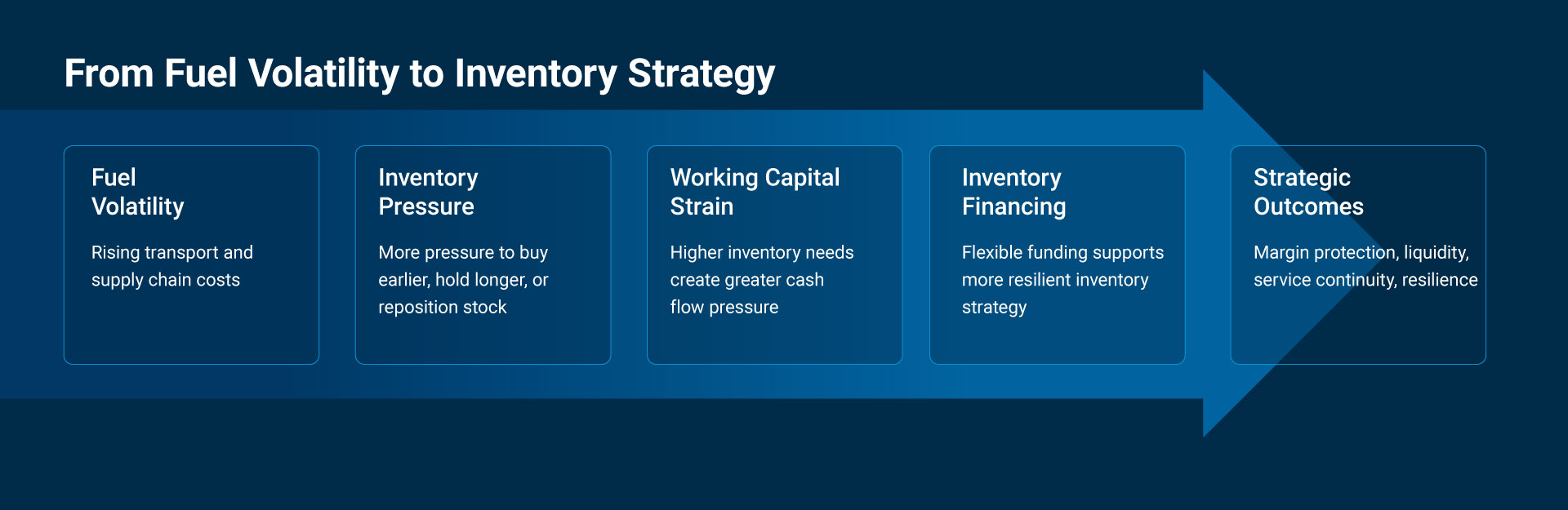
Seen this way, inventory financing is not just a mechanism for funding goods on hand. It is a way to support a more deliberate inventory strategy while balancing resilience, service, and working capital performance.
With the right structure, inventory financing can help companies:
- Secure supply earlier: Finance inventory in advance so the business can lock in critical materials without taking on the full working capital burden upfront.
- Carry inventory longer: Maintain more buffer stock when volatility makes lean, just-in-time replenishment harder to sustain.
- Position inventory strategically: Place stock closer to demand, production, or critical network nodes to improve responsiveness and reduce disruption risk.
- Support service continuity: Keep critical inventory available when lead times stretch or transportation costs become more volatile.
- Preserve liquidity: Create more flexibility to support resilience-oriented inventory decisions without putting unnecessary strain on cash flow.
- Improve delivery performance: Strengthen on-time delivery and customer satisfaction while supporting broader end-to-end supply chain goals.
Where Inventory Financing Creates Practical Value
The strongest inventory financing strategies are not one-size-fits-all. They are built around where pressure exists in the supply chain lifecycle. The most effective approach is to match the structure to the business need at each stage.
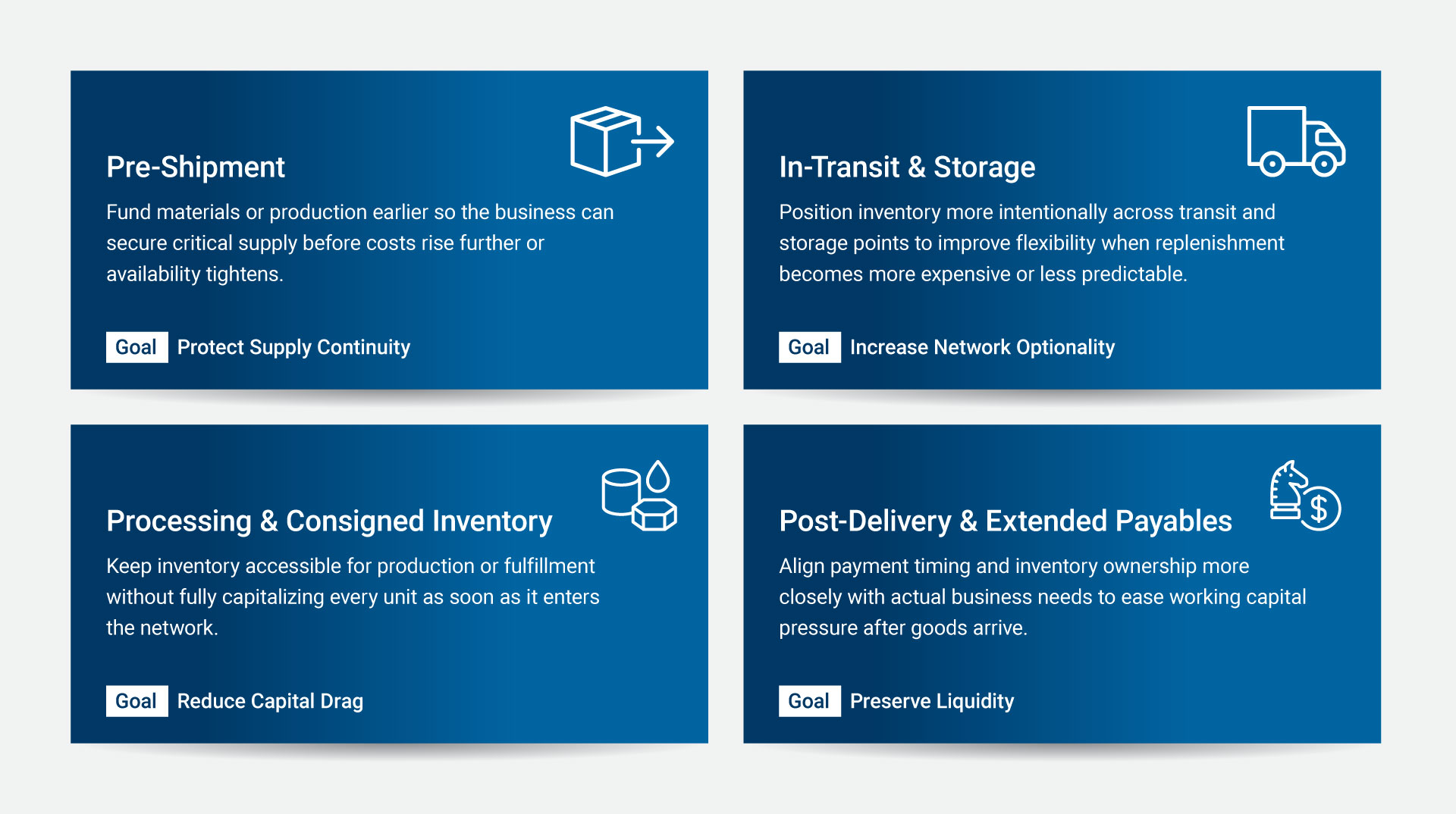
Viewed this way, inventory financing is less a single solution than a set of tools that can support different goals at different stages. The sections below look at where these models create the most practical value and what supply chain leaders should consider when applying them.
Pre-shipment: funding supply earlier without slowing production
When input costs are rising or supply availability is tightening, businesses often need to commit earlier than they would in a stable market. The challenge is sectring materials or production capacity without putting immediate strain on cash flow.
Best practices:
- Prioritize critical inputs: Focus pre-shipment financing on materials or components that are most exposed to cost swings, long lead times, or supply disruption.
- Align financing with sourcing strategy: Use financing to support planned buys tied to real demand, supplier commitments, or production schedules rather than opportunistic overbuying.
- Protect production continuity: Structure early buys so the business can secure supply without delaying manufacturing or creating new cash constraints elsewhere.
- Look for cost leverage: Pair earlier funding decisions with procurement actions that can improve purchase timing, pricing, or supplier terms.
In-transit and storage: improving optionality when placement matters more
Sometimes the key question is not whether inventory should be held, but where it should sit. When transportation costs are volatile and replenishment is less predictable, inventory placement becomes a more strategic decision.
Best practices:
- Position inventory intentionally: Place stock closer to demand, production, or key distribution points where it can reduce response time and disruption risk.
- Match placement to volatility: Use in-transit or storage strategies for categories where frequent replenishment has become too expensive or too uncertain.
- Balance efficiency with resilience: Avoid treating all inventory the same; some goods may still fit lean models, while others require more buffer or regional positioning.
- Maintain visibility across nodes: Ensure teams can track what is held, where it is held, and when it can be deployed so optionality does not create confusion.
Processing and consigned inventory: reducing capital drag while keeping supply accessible
For some businesses, the priority is maintaining access to inventory without fully capitalizing it the moment it enters the network. That is where processing and consigned models can create practical value.
Best practices:
- Use consigned models selectively: Apply them where supply assurance matters, but immediate ownership adds unnecessary pressure to working capital.
- Keep supply close to consumption: Structure inventory so it remains accessible for production or fulfillment without forcing early capitalization of every unit.
- Clarify ownership and triggers: Define exactly when inventory transfers, how it is accounted for, and what events trigger financial responsibility.
- Support cost discipline: Use these models to reduce capital intensity while still protecting continuity and pricing stability.
Post-delivery and extended payables: aligning inventory ownership with working capital goals
The working capital challenge does not end when goods arrive. Payment timing, ownership structure, and system coordination all influence whether inventory supports liquidity or constrains it.
Best practices:
- Extend terms where it makes sense: Use longer payment structures to create working capital relief in categories where inventory must be held longer or in greater quantities.
- Coordinate finance and operations: Align payment terms with how inventory is received, stored, consumed, and reported across the business.
- Integrate systems early: Make sure supplier, logistics, and ERP data are aligned so the model does not become administratively heavy.
- Design for scalability: Build structures that can support multiple suppliers, geographies, and inventory types as needs evolve.
What Supply Chain Leaders Should Evaluate Now
Inventory financing is not a universal answer for every SKU or every company. But for businesses exposed to fuel-driven cost swings, long lead times, or service-critical supply, it deserves a far more strategic review than it often receives.
A good starting point is not “Should we finance inventory?” It is “Where is fuel volatility forcing us to behave differently?” That usually leads to better questions:
- Which categories are now too risky to buy late?
- Which supply lanes have become too expensive or too unpredictable to depend on for frequent replenishment?
- Which inventory positions protect revenue or production most directly?
- And where is the real bottleneck: raw materials, transit, warehouse positioning, or payable timing?
Jabil’s own 2024 Supply Chain Resilience Survey found that 75% of companies planned to use cost-effective inventory management strategies to reduce operating costs in 2025. That makes sense. In a volatile environment, inventory is no longer just a cost center to be squeezed. It is one of the clearest levers companies have to balance continuity, cost, and customer performance.
Partnering with Jabil PSCS on Inventory Financing Strategy
For organizations managing high-stakes, high-variability supply chains, repeatable performance requires more than point solutions. It requires an operating partner with the scale and expertise to help balance supply assurance, working capital, and cost control when volatility reshapes inventory strategy.
Jabil brings 60+ years of practitioner experience managing complex global supply chains for 400+ leading brands, supported by 100+ locations across 25+ countries and 38,000+ supplier relationships.
From targeted advisory and assessments to managed services, logistics execution, and data-informed market intelligence, we help leaders turn inventory financing into a practical lever for stronger cash flow, greater resilience, and more deliberate end-to-end supply chain execution.
To explore how Jabil can support a more resilient and capital-efficient inventory strategy, connect with our team!