How Seamless Integration Speeds Up Procurement Processes

September 2, 2026 | By Jabil Procurement & Supply Chain Team
A sophisticated technology stack does not automatically create a fast procurement process. When systems operate independently, employees still spend valuable time transferring data, reconciling records, and following up on decisions. These procurement integration gaps can slow execution at the exact moments when speed matters most.
Delays often emerge in the handoffs between requisition and approval, approval and purchase order, supplier response and buyer action, or receipt and invoice reconciliation. The result is more than administrative friction. Slow procurement decisions can affect material availability, production continuity, working capital, supplier responsiveness, and the organization’s ability to react to risk.
Procurement speed ultimately depends on how effectively data, systems, and decisions move together across the full process
What Is Procurement Integration?
Procurement is the end-to-end process of identifying business needs, sourcing suppliers, negotiating agreements, purchasing goods and services, managing supplier performance, and coordinating payment, compliance, and risk. Procurement integration connects the technologies, enterprise systems, supplier platforms, and data sources that support those activities so information can move consistently across the purchasing lifecycle.
The goal is not simply to place more tools within the procurement function. It is to create a connected operating environment in which data entered in one system can inform the next workflow without unnecessary re-entry, reconciliation, or delay. From Jabil’s perspective, procurement integration delivers the most value when it connects purchasing workflows with planning, finance, supplier management, logistics, manufacturing, and broader operational execution.
What Systems Are Typically Integrated in Procurement?
A procurement ecosystem may connect:
- Enterprise resource planning systems
- E-procurement and source-to-pay platforms
- Supplier portals and supplier management tools
- Contract lifecycle management systems
- Accounts payable and financial platforms
- Inventory, planning, manufacturing, and logistics systems
- Risk, compliance, sustainability, and market intelligence data
- Analytics platforms, data warehouses, and business intelligence tools
The specific architecture will vary, but the objective remains the same. It is to provide stakeholders with timely, consistent information as work moves across systems and functions.
Integration, Automation, Centralization, and Orchestration Are Not the Same
These concepts are closely related, but they serve different purposes. Integration connects systems and data. Automation executes repeatable tasks. Centralization consolidates control or decision-making. Orchestration coordinates people, processes, systems, and decisions across the end-to-end workflow.
A company can automate an isolated task without creating an integrated process. It can also centralize procurement authority while still relying on disconnected systems. The greatest gains occur when these capabilities work together to support faster, more coordinated execution.
How Seamless Integration Improves Procurement Speed
Procurement cycle time is rarely lost in one major delay. It accumulates through repeated data entry, approval queues, information searches, manual validation, and exception follow-up. Seamless integration speeds up procurement by reducing the time between these steps and allowing work to move forward without waiting for someone to manually connect systems, information, or stakeholders.
Ryan Johnson, who leads Jabil’s procurement technology practice, described this evolution on End-to-End Insights:
"Procurement technology once focused primarily on speeding up transactions-issuing purchase orders, paying vendors, and onboarding suppliers more efficiently. While those capabilities still matter, companies are now looking for technology that goes further, enabling stronger supplier performance, proactive risk management, cost optimization, and strategic insights across the end-to-end procurement lifecycle."

Together, these points of friction form five common bottlenecks that can slow the procurement process from request through execution:
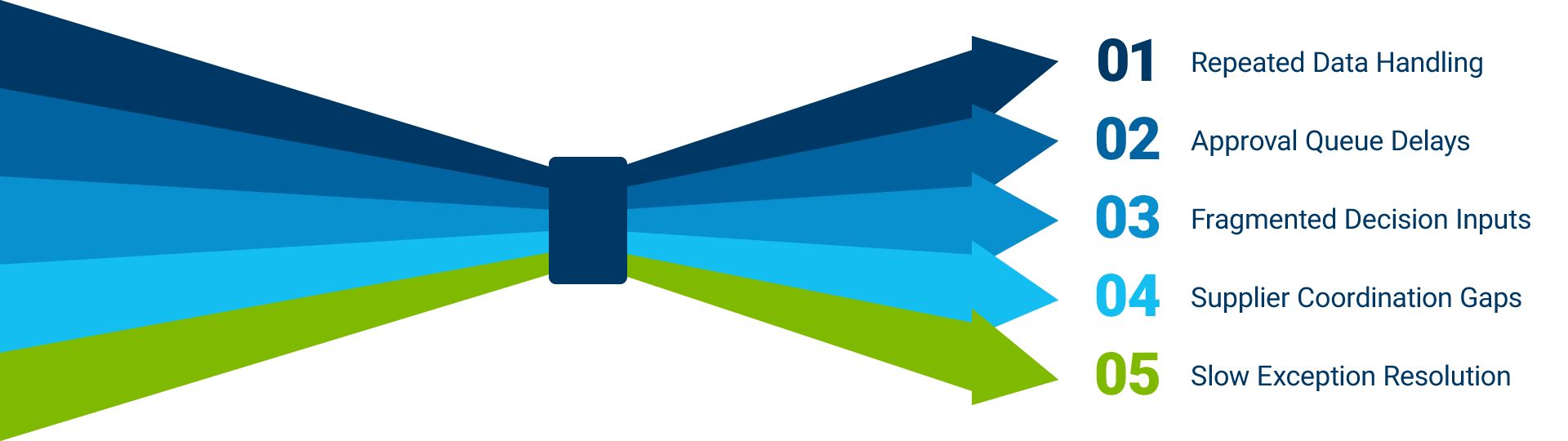
Removing the Repeated Data Handling Bottleneck
Bottleneck: When supplier records, pricing, material information, purchase orders, receipts, and invoices sit across separate platforms, teams may need to enter the same information multiple times. They must then investigate discrepancies, correct errors, and determine which record is accurate before the process can continue.
Breakthrough: Integration allows validated information to move from the system where it originates into downstream procurement, supplier, finance, and reporting workflows. With fewer manual touches and conflicting records, requests, orders, and payments can advance without repeatedly stopping for data entry or reconciliation.
Breaking Through Approval Queue Delays
Bottleneck: Purchase requests often slow down while teams check budgets, confirm policy compliance, identify the correct approver, or follow up on outstanding decisions. Email chains and spreadsheet trackers can add further delays without giving stakeholders a reliable view of the request’s status.
Breakthrough: A connected workflow can validate a requisition against established rules, route it to the appropriate decision-maker, and generate a purchase order once approval is complete. Order information can then move directly to supplier and financial systems, creating a more continuous process with fewer administrative pauses.
Connecting Decision Inputs for Faster Action
Bottleneck: Buyers frequently need to consult supplier performance records, contracts, inventory levels, pricing, demand requirements, market signals, and risk data before taking action. When that information is spread across systems, more time is spent gathering and validating it than evaluating the decision itself.
Breakthrough: Integration brings relevant information into the workflow where the decision is being made. Buyers can compare options, assess tradeoffs, and act with greater confidence rather than searching across disconnected sources. From Jabil’s perspective, visibility does not create speed on its own. Information must be organized, prioritized, and connected to a decision or workflow before it can improve execution.
Closing Supplier Coordination Gaps
Bottleneck: Buyers and suppliers may communicate through disconnected emails, portals, spreadsheets, and internal systems. When order changes, delivery updates, documentation, or performance issues are not visible to both sides, teams spend more time confirming information and determining what action is required.
Breakthrough: Integrated supplier platforms and procurement workflows give buyers and suppliers access to synchronized order information, shared documentation, performance data, and structured issue-management processes. This reduces back-and-forth communication and helps both parties respond faster when requirements or supply conditions change.
Accelerating Exception Resolution
Bottleneck: Procurement processes often slow most when something goes wrong. A supplier misses a delivery commitment, a material becomes constrained, an invoice does not match a purchase order, a contract approaches expiration, or an alternate source requires approval.
Breakthrough: Connected systems can surface the relevant supplier, order, contract, inventory, and risk information while routing the issue to the appropriate stakeholder. Instead of beginning with a manual investigation, teams can begin with the context needed to evaluate the problem and coordinate a response.
What Seamless Procurement Integration Requires
Procurement integration is not simply a matter of installing connectors between platforms. Systems can exchange information and still produce slow, inconsistent workflows when the underlying data, processes, controls, and operating model remain fragmented. To create faster, connected execution, organizations need a strong foundation that supports how information moves, how decisions are made, and how people work across the procurement lifecycle.
Trusted and Governed Data
Procurement systems need consistent supplier records, material codes, pricing structures, payment terms, and category definitions. Integration can move information faster, but it can also spread incomplete or inconsistent data across more workflows.
Clear master-data ownership, validation rules, common definitions, cleansing processes, and ongoing quality monitoring help create a reliable foundation for automation, reporting, analytics, and AI-enabled decisions.
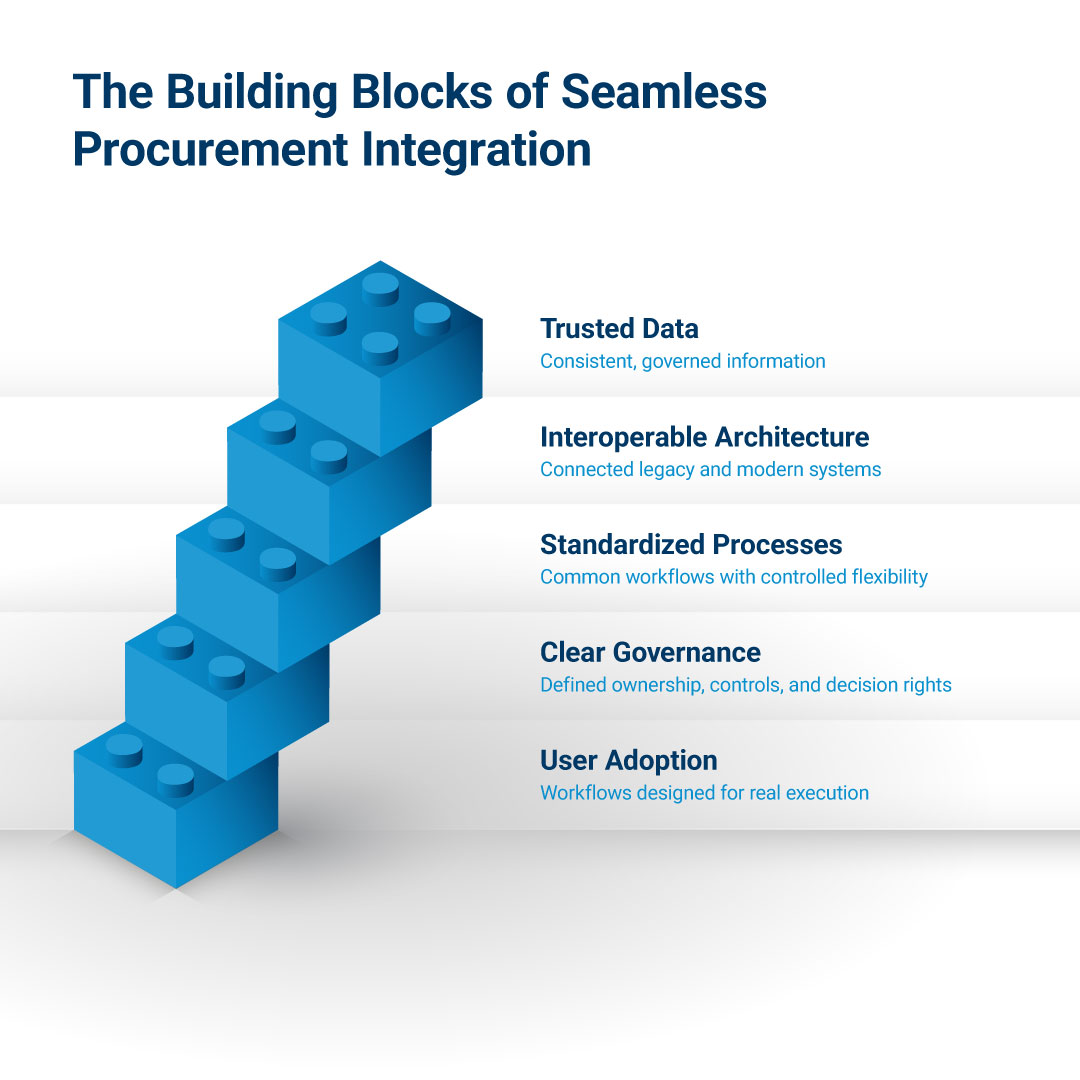
An Interoperable Technology Architecture
Many procurement environments combine legacy ERP systems, custom databases, regional platforms, cloud applications, and supplier tools that were not designed to work together.
Seamless integration does not necessarily require replacing every system. APIs, middleware, integration platforms, data mapping, and phased modernization can connect existing technologies while limiting disruption to day-to-day operations.
Standardized Core Processes
Technology cannot create a seamless workflow when functions, regions, or business units follow conflicting approval paths, purchasing rules, and ownership models.
Organizations should standardize the core process while allowing controlled variation where categories, regulations, markets, or customer requirements demand it. The objective is consistency without eliminating necessary operational flexibility.
Clear Governance and Decision Rights
Connected systems introduce more data exchanges, automated actions, access points, and dependencies between procurement, finance, IT, operations, and suppliers.
Organizations need defined ownership for data, workflows, approvals, exceptions, security controls, and audit requirements. Building those controls into the operating model early helps integration move forward without weakening accountability or compliance.
Adoption Built Into the Design
An integration can be technically successful and still fail to improve performance if employees continue using spreadsheets, email, and manual workarounds.
Ryan Johnson, who leads Jabil’s procurement technology practice, explained the distinction on End-to-End Insights:
“Adoption is when people actually trust the process and see value in using it. Training is a metric to identify compliance: Were you trained or not? But if people are using the system, trusting the process, and knowing how to access information, that’s adoption. Training is not the end-all, be-all.”
Users should therefore be involved in workflow design, testing, and refinement. Training remains important, but lasting adoption depends on whether the connected process is simpler, clearer, and more useful than the process it replaces.
The Roadmap to Seamless Procurement Integration
The foundations of integration may be consistent across organizations, but the path to building them should reflect each company’s systems, workflows, and operational priorities. Rather than beginning with a technology purchase, companies should first identify where disconnected processes create the greatest delays, errors, and business risk. A phased roadmap helps turn those findings into measurable improvements without attempting to transform the entire procurement environment at once.
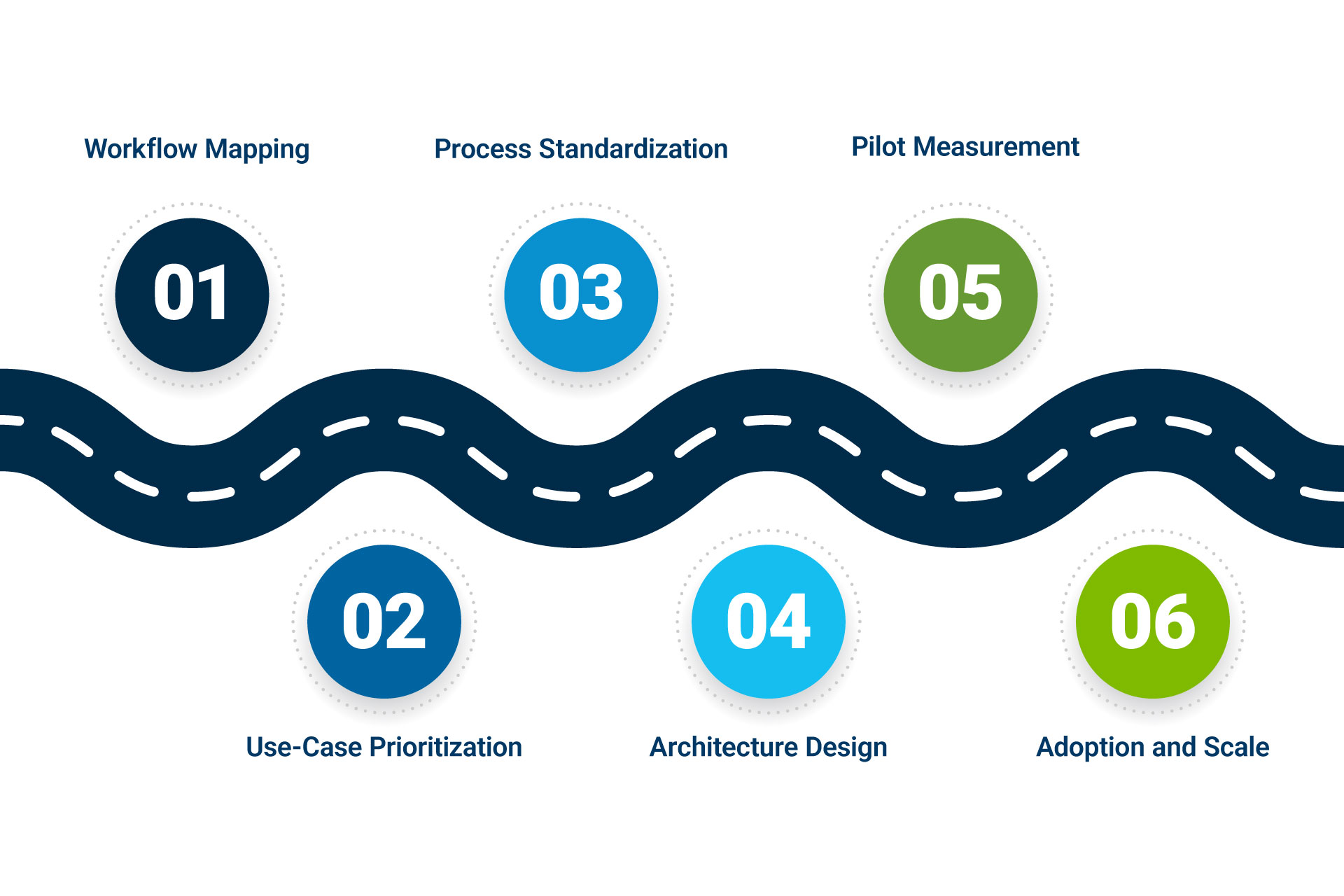
1. Map the Current Workflow
Document the systems, stakeholders, approval paths, handoffs, workarounds, and exception processes involved in moving from a business need to supplier execution. This reveals where employees lose time transferring information, validating records, or waiting for decisions.
Best Practice: Map one end-to-end workflow at the transaction level before expanding the assessment across the procurement organization.
2. Prioritize High-Value Use Cases
Focus first on workflows where delays or errors have the greatest operational impact. Common starting points include requisition routing, supplier onboarding, purchase-order processing, invoice matching, material-shortage response, and supplier performance management.
Best Practice: Rank potential use cases based on cycle-time impact, error frequency, business risk, and implementation feasibility.
3. Standardize Data and Process Rules
Align supplier records, naming conventions, approval thresholds, workflow requirements, and decision rights before connecting or automating the process. Integration cannot create consistency when the underlying rules remain unclear.
Best Practice: Assign clear owners to critical data fields and process rules before integration design begins.
4. Design the Integration Architecture
Determine how procurement, ERP, finance, supplier, planning, and data platforms will exchange information. Depending on the environment, this may involve native connectors, APIs, middleware, integration platforms, or phased modernization.
Best Practice: Design the architecture around workflow requirements and business outcomes rather than individual software features.
5. Pilot and Measure the Workflow
Establish baseline measures for cycle time, error rates, manual touches, user effort, and supplier response. Test the connected workflow within a defined category, region, or business unit so results can be evaluated before broader deployment.
Best Practice: Compare pilot performance with the original baseline and gather feedback from the employees and suppliers using the workflow.
6. Scale Through Adoption and Improvement
Expand the integration based on measurable outcomes rather than technical completion alone. Continue monitoring workflow performance, data quality, user adoption, and emerging bottlenecks as the process scales.
Best Practice: Expand only after the pilot meets defined performance and adoption targets, then continue refining the workflow as conditions change.
Explore how Jabil connects procurement technology with practical execution.
The Future of Integrated Procurement
The next phase of procurement integration will move beyond simply transferring data between systems. Connected platforms will interpret real-time signals, coordinate work across functions, and help teams act faster. AI will expand these capabilities, but its value will still depend on trusted data, interoperable technology, and clear governance.
As Graham Scott, Chief Procurement Officer at Jabil, explained on the End-to-End Insights episode “Why Procurement Is More Than Cost Savings,”
“Technology is creating new possibilities across procurement and supply chain. At Jabil, we utilize advanced technology and AI to improve visibility, anticipate challenges and build smarter, more resilient supply chains that help customers navigate complexity with confidence.”

These emerging capabilities highlight where AI can deliver meaningful value when applied with clear purpose and integration.
- Real-Time Execution: Integrated procurement systems will increasingly respond to live operational signals, identify at-risk orders, and trigger the next action without waiting for manual review.
- Agentic Workflow Orchestration: Specialized AI agents will coordinate multistep work across procurement, finance, and supply chain rather than operating as isolated assistants.
- Cross-Platform Interoperability: Future procurement environments will need a governed control layer that allows AI agents, enterprise applications, and third-party tools to work together securely.
- Embedded Compliance Intelligence: Regulatory, sustainability, and risk requirements will increasingly be translated into system rules and evaluated directly within sourcing and purchasing workflows.
- Human-Governed Autonomy: AI will handle more analysis and routine coordination while procurement professionals retain control over consequential supplier, risk, and business decisions.
The future is not a fully autonomous procurement function. It is a more responsive operating model in which connected systems surface the right information, coordinate the next step, and help people make better decisions at the moment action is required.
Explore more Jabil insights on procurement and supply chain transformation.
FAQs for Procurement Integration
How long does procurement integration take?
The timeline depends on the number of systems, quality of the underlying data, complexity of the workflow, and scope of the implementation. A targeted integration for one high-value process can move faster than an enterprise-wide transformation, which is why phased pilots are often more practical than connecting the entire procurement environment at once.
Who should own a procurement integration initiative?
Procurement should typically own the business requirements and desired workflow outcomes, while IT supports architecture, security, data exchange, and system reliability. Finance, operations, planning, legal, and supplier-management teams may also need defined roles, depending on which processes and decisions the integration affects.
How should companies measure the ROI of procurement integration?
Organizations should compare post-integration results against established baselines for cycle time, manual touches, error rates, policy compliance, supplier response, and employee effort. The broader business case may also include avoided disruptions, improved working capital, reduced administrative costs, and greater capacity for procurement teams to focus on strategic work.
How does procurement integration affect cybersecurity and data privacy?
Connecting more systems increases the number of data exchanges, access points, and third-party dependencies that must be governed. Strong integration programs incorporate identity and access controls, encryption, API governance, audit trails, data-retention policies, continuous monitoring, and segregation of duties from the beginning rather than treating security as a final implementation step.
Partnering with Jabil
For organizations managing high-stakes, high-variability supply chains, repeatable performance requires more than connected tools. It requires an operating partner that can align technology, data, processes, governance, and people around faster execution. From targeted assessments and advisory to managed services, logistics execution, and data-informed market intelligence, Jabil helps leaders move from insight to execution across procurement, supplier management, planning, logistics, and broader supply chain operations.
Jabil brings practitioner depth and global operating scale to help organizations connect systems, streamline workflows, and turn procurement visibility into faster, better-coordinated decisions. The result is greater resilience, control, and speed without relying on one-off workarounds or isolated technology solutions.
With 60+ years of supply chain expertise supporting 400+ leading brands, Jabil is backed by 100+ locations across 25+ countries, 38,000+ supplier relationships, $25B+ in annual procurement spend, and 3,000+ supply chain experts. This combination of scale, expertise, and operational experience helps deliver outcomes that hold up under complexity and volatility.