Key Challenges in Implementing Supply Planning and How to Overcome Them

July 24, 2026 | By Jabil Procurement & Supply Chain Team
A supply plan can give teams confidence until it meets the realities of execution. The key challenges in implementing supply planning often emerge when demand shifts, supplier commitments change, or capacity becomes constrained. At that point, planning becomes less about building the right spreadsheet and more about making decisions the business can actually execute.
Supply planning plays a critical role in connecting demand with execution. It helps companies determine how to balance customer requirements with available materials, supplier capacity, production resources, inventory levels, logistics constraints, and service commitments. Done well, it gives teams a clearer view of what is possible, where constraints exist, and which tradeoffs need to be made.
But implementation becomes difficult when plans are built on incomplete data, disconnected systems, siloed decision-making, or assumptions that do not reflect real operating conditions. The strongest supply planning processes give teams the visibility to see constraints earlier, the alignment to make tradeoffs faster, and the execution discipline to act with confidence.
Key Takeaways
- Execution Matters: Supply planning is only valuable when teams can turn plans into coordinated action across procurement, production, inventory, logistics, and customer commitments.
- Constraints Shape Feasibility: Effective supply planning must account for supplier capacity, material availability, production limits, inventory positions, and logistics realities.
- Data Drives Confidence: Teams are more likely to trust and act on supply plans when the underlying data is accurate, current, and connected across systems.
- Alignment Reduces Risk: A shared planning cadence, clear decision rights, and common KPIs help teams manage tradeoffs before issues become customer-facing problems.
- Visibility Enables Speed: Integrated systems and real-time visibility help planners identify deviations sooner and focus on the exceptions that require action.
- AI Requires Readiness: AI can improve forecasting, scenario planning, and exception management, but only when supported by strong data, systems, and process governance.
What Is Supply Planning in the Supply Chain?
Before companies can address the key challenges in implementing supply planning, they need a clear understanding of what supply planning is meant to do. At its core, supply planning connects demand expectations to the resources, constraints, and decisions required to fulfill them.
Supply planning defined
Supply planning is the process of determining how a company will meet expected demand using available materials, supplier capacity, production resources, inventory, and logistics capabilities. It translates the demand plan into feasible supply actions by evaluating constraints, sequencing decisions, and aligning supply with operational realities.
Rather than focusing on discrete tasks, supply planning creates a coordinated approach to sourcing, production, inventory positioning, and distribution. It gives teams a more realistic view of what the business can deliver while balancing service expectations, cost efficiency, working capital, and operational performance.
How supply planning fits into supply chain operations
Supply planning sits between demand planning and execution. Demand planning provides a view of what the market, channel, or customer is expected to need. Supply planning determines how the business can fulfill that demand based on real-world constraints across suppliers, materials, capacity, inventory, production, and logistics.
Because of that role, supply planning operates as a cross-functional coordination layer, not a standalone activity. It connects commercial, operational, and financial inputs and works alongside inventory planning, production planning, procurement planning, capacity planning, sales and operations planning, and integrated business planning.
When these processes are aligned, supply planning gives teams earlier visibility into constraints, highlights potential risks, and supports better tradeoffs before execution begins.
Explore Jabil’s supply chain services to connect planning, visibility, and execution across complex operations.
Key Challenges in Implementing Supply Planning
The key challenges in implementing supply planning often come from the gap between what a company expects to happen and what its operations can realistically support. Demand changes. Supplier commitments shift. Capacity becomes constrained. Data does not always reflect current conditions. When these variables are not connected through a disciplined planning process, supply planning can become reactive instead of decision-ready.
Operational Impact and Practical Fixes
| Challenge | Operational Impact | Practical Fix |
|---|---|---|
| Demand variability | Stockouts, excess inventory, and schedule changes | Rolling forecasts, scenario planning, and product segmentation |
| Poor data accuracy | Low trust in plans and slower decisions | Master data ownership and high-impact data cleanup |
| Limited cross-functional alignment | Conflicting priorities and repeated escalations | Shared planning cadence, decision rights, and common KPIs |
| Supplier, material, and capacity constraints | Shortages, production delays, and customer order risk | Constraint-based planning, supplier visibility, and allocation rules |
| Disconnected planning systems | Manual reconciliation and limited visibility | Integrated planning platforms and standardized workflows |
| Weak execution handoff | Plans are updated but actions do not change | Exception-based workflows, escalation paths, and action tracking |
1. Demand Variability and Forecast Uncertainty
Demand variability makes it difficult to create a stable supply plan. Forecasts can change because of customer behavior, promotions, product launches, seasonal swings, market disruptions, or broader economic conditions. When those changes move faster than the supply chain can respond, the plan can quickly fall out of sync with operational reality.
Operational Impact: Demand variability can lead to stockouts, excess inventory, expediting costs, production schedule changes, supplier pressure, and missed service commitments.
Practical Fix: Companies can improve collaboration between sales, demand planning, supply planning, and operations. Rolling forecasts and scenario planning can help teams test different demand outcomes before they become urgent, while product segmentation by volatility, lead time, margin, and criticality can help determine where more flexibility is needed.
2. Poor Data Accuracy And Fragmented Master Data
Supply planning depends on reliable data. Bills of materials, supplier lead times, inventory records, production capacity, order status, and demand inputs all shape the supply plan. If that information is outdated, incomplete, or inconsistent across systems, teams may build plans around assumptions that do not match reality.
Operational Impact: Poor data accuracy can cause planners to overestimate available inventory, underestimate lead times, or rely on supplier commitments that do not reflect actual availability. It also slows decision-making because teams spend too much time questioning the data instead of acting on it.
Practical Fix: Companies should establish clear master data ownership and clean the data that most directly affects planning decisions first. High-impact areas often include lead times, inventory records, supplier capacity, open orders, production constraints, and bills of materials.
3. Limited Cross-Functional Alignment
Supply planning often breaks down when teams optimize around different priorities. Sales may focus on revenue. Procurement may focus on cost. Operations may focus on efficiency. Finance may focus on working capital. Each priority matters, but planning becomes difficult when teams are not working from a shared view of demand, supply, constraints, and tradeoffs.
Operational Impact: Limited alignment can create slow decisions, unclear ownership, repeated escalations, and plans that look reasonable in one function but fail across the broader supply chain.
Practical Fix: A stronger planning process requires a regular cross-functional cadence, clearly defined decision rights, and shared performance metrics. Service levels, inventory health, forecast accuracy, supply attainment, and schedule adherence can help teams evaluate planning decisions through a common operating lens.
4. Supplier, Material, And Capacity Constraints
Even a strong demand plan can fail if the supply base, materials pipeline, or production network cannot support it. Supplier delays, material shortages, constrained production lines, labor limitations, and long logistics lead times can all prevent the business from fulfilling demand as planned.
Operational Impact: Supplier, material, and capacity constraints can trigger shortages, allocation decisions, delayed production, premium freight, substitutions, and customer order risk.
Practical Fix: Companies need to build supplier and capacity constraints into the planning process earlier. That means improving visibility into supplier lead times, sub-tier risks, material availability, and production limits. It also means defining alternate sourcing, substitution, and allocation rules before disruption occurs.
5. Disconnected Planning Systems And Legacy Tools
Many organizations still rely on spreadsheets, manual updates, disconnected ERP data, or point solutions that do not communicate well. These tools may support individual planning tasks, but they often create friction when teams need a shared, current view of supply constraints and available options.
Operational Impact: Disconnected systems can create version-control issues, delayed updates, manual reconciliation, limited visibility across sites, suppliers, and business units, and an inability to run scenarios quickly.
Practical Fix: Companies can reduce this friction by integrating planning systems with ERP, procurement, inventory, supplier, manufacturing, and logistics data. Standardized workflows and digital supply chain tools can help create a more connected view of constraints, options, and execution priorities.
6. Weak Execution Handoff From Planning To Action
A supply plan is only useful if teams can act on it. Companies may identify a shortage, capacity gap, or demand shift, but still struggle to coordinate the response quickly enough across procurement, production, suppliers, logistics, and customer-facing teams.
Operational Impact: When the handoff from planning to execution is weak, plans are updated but execution does not change. Teams keep reacting instead of anticipating. Shortages are identified too late, escalations become routine, and the organization loses confidence in the planning process.
Practical Fix: Teams need to connect planning outputs to clear actions. That requires defined escalation paths, ownership for follow-through, and a way to track whether planned actions were completed. Exception-based planning can also help teams focus attention on the decisions that matter most, rather than reviewing every change with the same level of urgency.
Learn how Jabil’s procurement experts help turn planning constraints into coordinated action.
Aligning Demand, Supply, and Operations
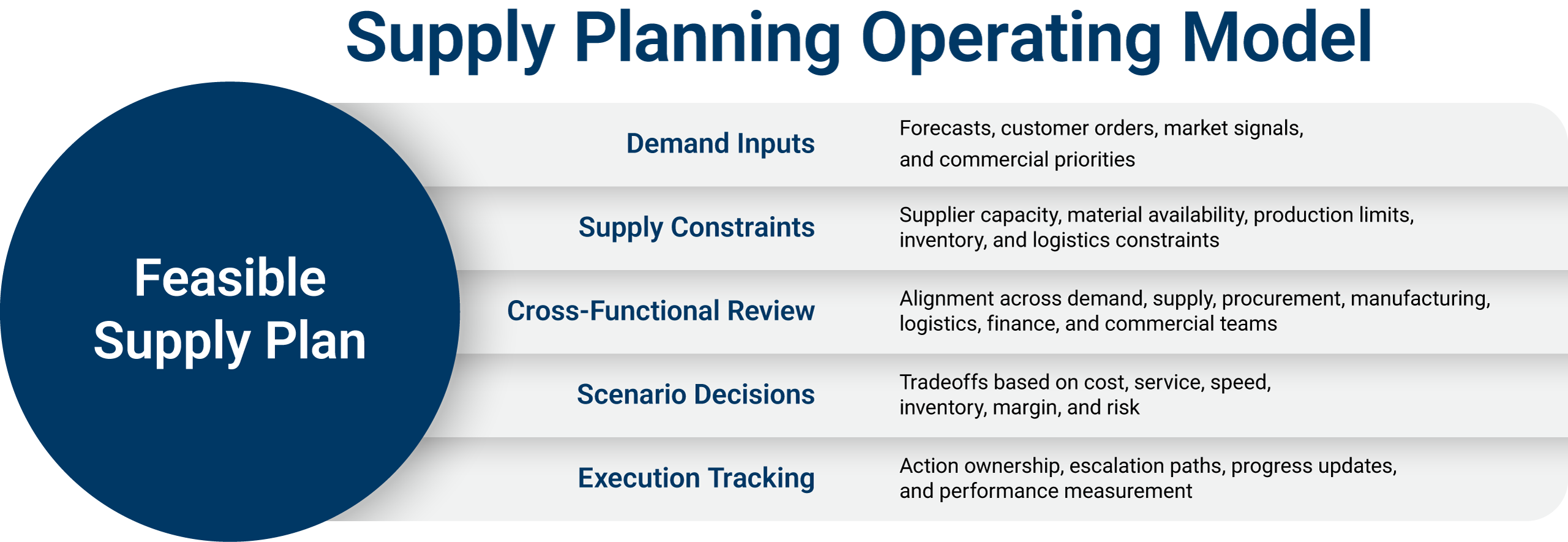
Addressing the key challenges in implementing supply planning requires more than better tools. Companies also need an operating model that connects demand inputs, supply constraints, cross-functional decisions, and execution follow-through.
The model below shows how those elements work together to create a feasible supply plan, one that reflects both business priorities and operational realities.
Build A Shared Planning Cadence
Supply planning improves when teams have regular, structured conversations about demand, supply, constraints, and risk. These discussions should bring together demand planning, supply planning, procurement, manufacturing, logistics, finance, and commercial teams so decisions are not made in isolation.
A strong planning cadence may include:
- Weekly or biweekly supply reviews
- Monthly S&OP or IBP meetings
- Exception-based escalation meetings
- Supplier risk or constraint reviews
- Executive tradeoff discussions for high-impact decisions
The goal is not to create more meetings. It is to create a repeatable process for surfacing constraints, evaluating options, and aligning action before problems reach the customer.
Define Ownership And Decision Rights
Supply planning also becomes more effective when teams understand who owns each input, decision, and response. Without clear ownership, plans can get delayed by unresolved questions or conflicting assumptions.
Companies should define:
- Who owns forecast inputs
- Who confirms supply commitments
- Who approves allocation decisions
- Who owns supplier recovery plans
- Who decides when to expedite
- Who communicates risk to commercial teams
Clear decision rights help teams move faster when conditions change. They also reduce the risk of duplicated work, unclear accountability, and last-minute escalation.
Use Planning To Manage Tradeoffs
Supply planning is ultimately a tradeoff-management process. Companies may need to balance service, cost, speed, margin, inventory, and risk in real time.
Common tradeoffs include whether to build ahead or preserve working capital, expedite materials or risk delayed fulfillment, prioritize one customer or product line over another, or use an alternate supplier at a higher cost. Strong supply planning makes these decisions visible earlier, so leaders can act with more context and fewer surprises.
Overcoming Data and System Limitations
Data and systems are often where supply planning ambitions meet operational reality. In Jabil’s podcast episode, Why Logistics Is More Than Execution, Priya Anand, Director of Logistics Services at Jabil, explained:
“The data helps us see what’s coming up, understand volatility in the market, make changes proactively, and keep the supply chain moving.”

That visibility is essential to effective supply planning. Companies do not need perfect data across the entire enterprise before they can improve, but they do need to identify the information that most directly affects planning decisions and create stronger connections between the systems where planning, execution, and performance data live.
Start With The Data That Drives Planning Decisions
The most important place to start is with the data that shapes supply decisions. If teams cannot trust the inputs behind the plan, they are less likely to trust the plan itself.
High-impact planning data often includes:
- Demand forecasts
- Inventory levels
- Supplier lead times
- Purchase orders
- Production capacity
- Material availability
- Bills of materials
- Logistics status
- Open customer orders
- Site-level constraints
Improving these data sets first can create faster progress than trying to clean every data source at once. It also helps teams focus governance efforts on the information that most affects service, cost, inventory, and execution risk.
Integrate Planning Systems With Execution Systems
Supply planning systems should not sit apart from ERP, procurement, supplier, manufacturing, logistics, and inventory systems. When these systems are disconnected, teams may have to reconcile conflicting information manually before they can make decisions.
That disconnect creates friction. A supply plan may show what the business wants to do, but not what the business is actually capable of doing. Stronger integration gives planners a clearer view of current constraints, available supply, production realities, and execution status.
Move Toward Real-Time Visibility And Exception-Based Planning
Real-time visibility helps teams identify deviations sooner. Exception-based planning helps them focus on the issues that actually require intervention.
Common exceptions may include:
- Demand exceeds available supply
- Supplier commitments change
- Inventory falls below threshold
- Capacity becomes constrained
- Lead times shift
- Open orders are at risk
- Logistics delays threaten production or delivery dates
This approach helps supply planning become more proactive. Instead of reviewing every data point with the same level of urgency, teams can prioritize the constraints, risks, and decisions most likely to affect business performance.
Explore Jabil’s market intelligence capabilities to improve visibility and act faster amid volatility.
FAQs About Supply Planning
What is supply planning in supply chain management?
Answer directly: supply planning determines how a company will meet demand using available materials, suppliers, capacity, inventory, and logistics resources.
What are the key challenges in implementing supply planning?
Mention demand variability, poor data accuracy, limited alignment, supplier constraints, capacity issues, disconnected systems, and difficulty turning plans into action.
Why is supply planning difficult for many organizations?
Focus on complexity: multiple systems, changing demand, constrained supply, global suppliers, siloed teams, and competing business priorities.
How does supply planning differ from demand planning?
Demand planning estimates what will be needed. Supply planning determines how the organization can fulfill that demand based on supply, inventory, capacity, and operational constraints.
How can companies improve supply planning processes?
Mention cross-functional collaboration, better data governance, integrated systems, scenario planning, supplier visibility, and clear execution workflows.
How can AI improve supply planning?
AI can help detect changes, identify risks, run scenarios, prioritize exceptions, and recommend actions, but it requires accurate data, integrated systems, and strong process governance.
Partnering with Jabil Procurement & Supply Chain Services
For organizations managing high-stakes, high-variability supply chains, effective supply planning depends on more than better forecasts or standalone tools. It requires the ability to connect demand, supply, data, systems, and execution in a way that helps teams make faster, more coordinated decisions.
From targeted assessments and advisory to managed services, logistics execution, and data-informed market intelligence, Jabil helps leaders move from insight to execution across procurement, planning, supplier management, logistics, manufacturing support, and customer fulfillment.
Jabil brings practitioner depth and global operating scale to help organizations execute with more resilience, control, and speed, without relying on one-off workarounds.
With 60+ years of supply chain expertise supporting 400+ leading brands, and backed by 100+ locations across 25+ countries and 38,000+ supplier relationships, plus $25B+ in annual procurement spend and 3,000+ supply chain experts, Jabil is built to deliver outcomes that hold up under volatility.