A Guide to Better Sourcing and Supply Chain Management

May 11, 2026 | By Jabil Procurement & Supply Chain Team
Whether it is a red-soled stiletto, a jet engine rotor, or the screen you are reading this on, every product carries the imprint of a sourcing decision. Someone must decide what to buy, who to buy from, where it should come from, and how much risk the business is willing to carry.
Those decisions shape far more than the purchase price. A supplier that looks cost-effective on paper may introduce longer lead times, added logistics complexity, quality issues, compliance exposure, or limited flexibility when demand changes. In a more volatile operating environment, sourcing can no longer be evaluated by unit price alone.
Better sourcing and supply chain management requires a broader view of how supplier decisions connect to procurement execution, logistics planning, inventory strategy, and overall business performance. This guide explains how sourcing fits within the broader supply chain and how companies can build more resilient, cost-effective sourcing strategies.
Key Points
- Sourcing Shapes Performance: Supplier decisions influence cost, lead times, quality, logistics, compliance, resilience, inventory, and customer delivery.
- Price Is Only One Factor: Effective sourcing considers total cost, including transportation, tariffs, working capital, quality risk, disruption exposure, and service requirements.
- Functions Must Work Together: Sourcing sets the supplier strategy, procurement executes purchases, and supply chain management coordinates the end-to-end flow of goods and services.
- Strategy Depends on Category: Critical components, commodity inputs, specialized materials, and regional supply needs may each require different sourcing models.
- Performance Requires Oversight: Scorecards, risk monitoring, quality reviews, and performance governance help turn sourcing strategy into repeatable supply chain results.
What Is Sourcing and Supply Chain Management?
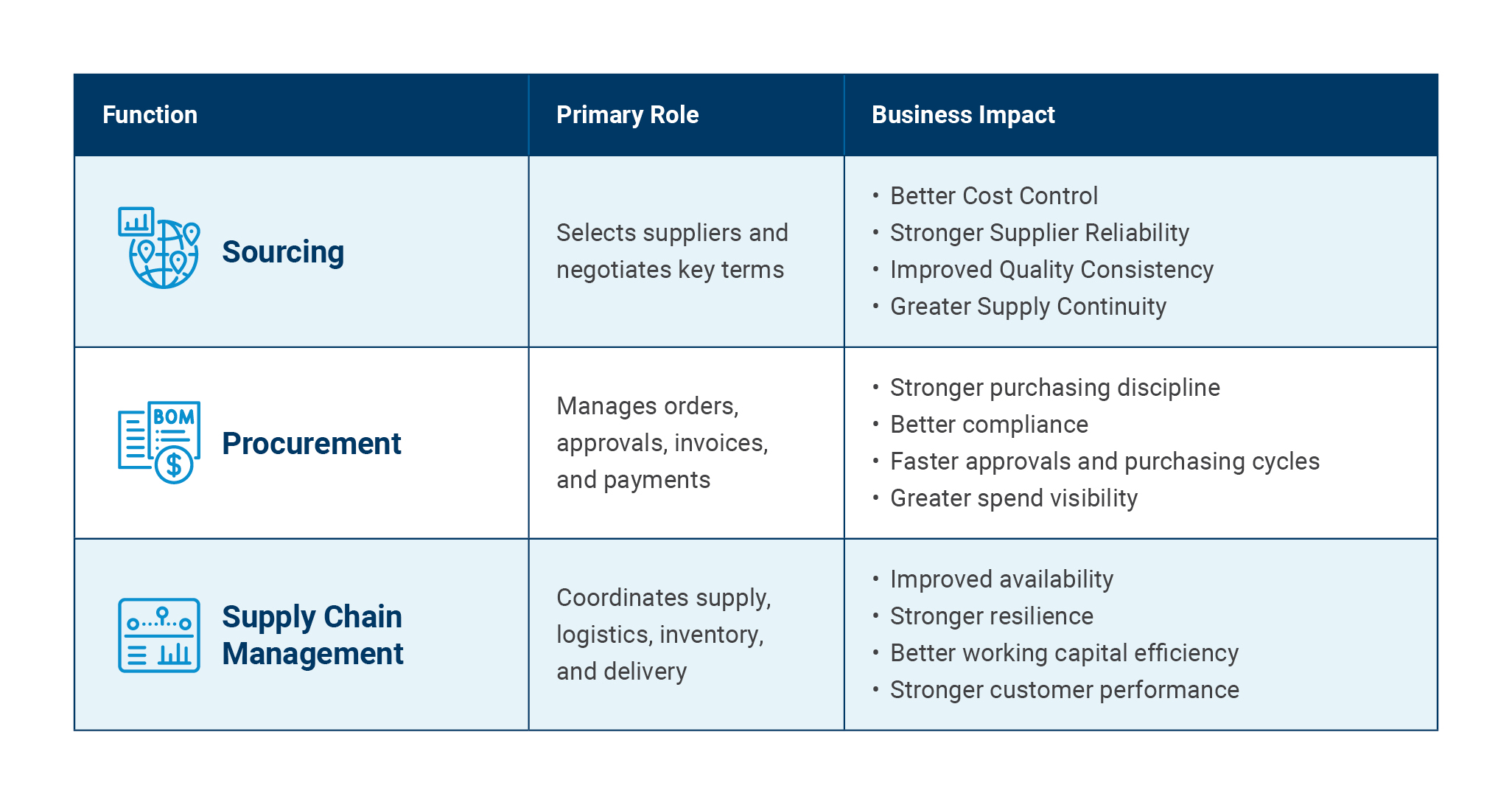
Sourcing and supply chain management are closely connected, but they are not the same function. Sourcing determines the supplier strategy, procurement executes the purchase, and supply chain management connects those decisions to the movement, availability, cost, and performance of goods and services.
What Is Sourcing?
Sourcing is the upstream process of identifying, evaluating, selecting, negotiating with, and managing suppliers. It is where companies decide which suppliers can best support their needs, what terms should govern those relationships, and what trade-offs they are willing to make across cost, risk, quality, capacity, and long-term value.
In practical terms, sourcing is about choice and leverage. It helps organizations compare supplier options, understand market conditions, negotiate stronger terms, and build a supplier base that supports business goals.
What Is Procurement?
Procurement is the execution layer that turns sourcing decisions into transactions. Once suppliers are selected and terms are established, procurement manages the buying process through purchase orders, approvals, receiving, invoice matching, payment, and compliance.
If sourcing determines the path, procurement keeps the process controlled, documented, and moving.
What Is Supply Chain Management?
Supply chain management is the broader coordination of sourcing, procurement, logistics, inventory, production, distribution, and customer delivery. It connects supplier decisions to how goods and services flow through the business.
This is where sourcing becomes more than a supplier selection exercise. The right sourcing strategy can improve availability, resilience, quality, and customer performance. The wrong one can create delays, cost overruns, compliance issues, and operational disruption.
How Sourcing Fits Into the Supply Chain Process
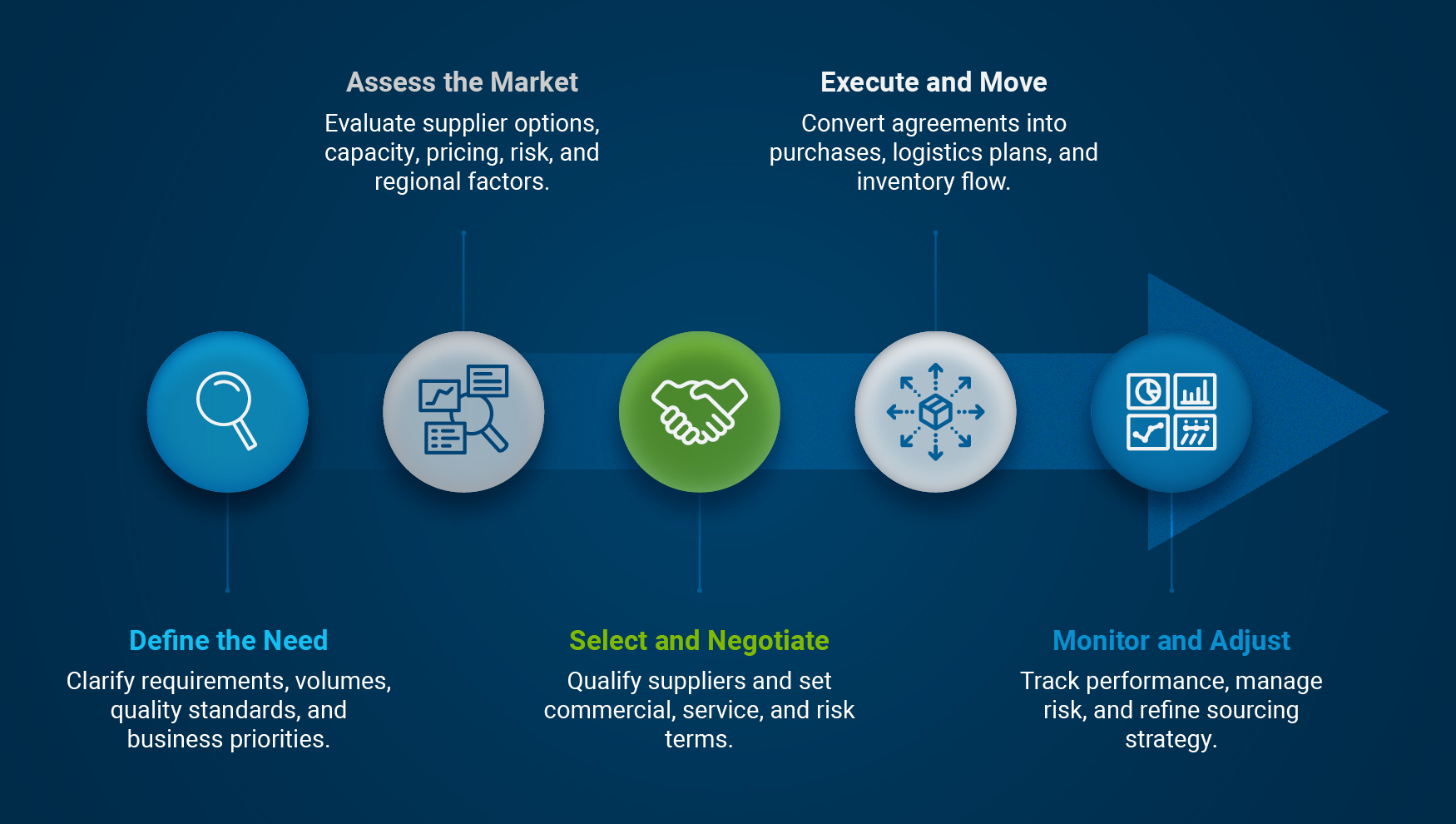
Sourcing begins long before a purchase order is issued. It starts when a business identifies a need, defines the requirements for a product or service, and evaluates the supplier market. Those early decisions shape the options available to procurement, logistics, operations, and finance later in the process.
Why Supplier Decisions Affect the Entire Supply Chain
A supplier may look strong during negotiation, but its full impact is measured across the supply chain. Supplier selection affects product availability, quality, lead times, logistics costs, and operational flexibility. A supplier with low pricing but long transit times may create inventory pressure. A supplier with strong technical capabilities may support innovation, production scalability, and continuity planning. A supplier in a high-risk region may introduce customs exposure, tariff volatility, carbon implications, or added transportation complexity.
The same is true for negotiated terms. Payment timing can affect working capital. Inventory ownership terms can influence balance sheet exposure and stock availability. Service-level expectations can determine how quickly issues are resolved when demand changes, shipments are delayed, or quality concerns emerge.
The Sourcing Process in Practice
In practice, the sourcing process often follows a connected path.
Better sourcing starts by recognizing that the supplier award is not the finish line. It is the point where strategy becomes execution. From there, each decision shapes procurement, logistics, inventory, production, and customer delivery.
Key Strategies for Effective Sourcing and Supply Chain Management
Effective sourcing and supply chain management requires more than choosing between the lowest-cost suppliers. The right strategy depends on what the business is buying, how critical the category is, how volatile demand may be, and how much risk the organization can absorb. A sourcing model that works for a commodity input may not work for a highly engineered component, a regulated product, or a material with limited global supply.
Strategic Sourcing
Strategic sourcing is a structured approach to aligning supplier decisions with business objectives. It considers cost, quality, resilience, capacity, compliance, innovation, and long-term value before a supplier is selected.
The goal is not simply to negotiate better prices. It is to design a supplier base that supports how the business needs to operate. For some categories, that may mean consolidating spend with fewer suppliers to improve leverage and consistency. For others, it may mean adding qualified alternatives to reduce exposure and improve continuity.
Supplier Diversification
Supplier diversification helps companies reduce dependency on one supplier, facility, or region. However, diversification should be deliberate, not automatic.
Single sourcing can support specialization, quality consistency, and deeper supplier collaboration, but it can also create dependency. Dual sourcing can improve continuity, flexibility, and negotiation posture, but it adds qualification work and management complexity. Multi-sourcing can build redundancy and capacity, but it may also increase administrative burden and quality variation if governance is weak.
The strongest approach is category specific. Critical components may require dual sourcing or qualified alternates. Commodity categories may benefit from broader competition. Specialized inputs may call for a closer strategic supplier relationship.
Regional and Global Sourcing
Global sourcing can provide access to lower costs, specialized capabilities, and expanded supplier markets. Local sourcing and nearshoring can improve speed, responsiveness, and regional resilience. The right mix depends on total cost, customer location, lead time, compliance requirements, logistics risk, supply availability, and the business impact of disruption.
For many companies, the question is no longer whether global or regional sourcing is better. It is how to build a network that balances cost efficiency with operational flexibility.
Supplier Relationship Management
Sourcing value does not end when the contract is signed. Supplier performance has to be managed through scorecards, business reviews, quality checks, risk monitoring, service-level tracking, and continuous improvement.
Strong supplier relationship management gives companies a clearer view of performance and a better path to address issues before they become supply chain failures.
Total Cost of Ownership
Unit price is only one part of sourcing value. Effective sourcing considers the full cost of doing business with a supplier, including transportation, tariffs, customs, inventory carrying costs, quality issues, compliance requirements, lead time, and disruption risk.
A supplier with the lowest bid may not deliver the lowest total cost. Better sourcing evaluates the full operational impact before the award decision is made.
How Sourcing Impacts Supply Chain Performance
Sourcing decisions create the operating conditions the rest of the supply chain has to manage. A supplier selected for a low unit price may still increase total cost if it creates longer lead times, higher transportation expense, quality issues, compliance exposure, or inventory risk. A supplier chosen for reliability, responsiveness, and fit can improve performance well beyond the purchasing function.
That is why sourcing should be treated as an ongoing supply chain performance lever, not a one-time supplier award. The best supplier decision is not always the lowest bid. It is the decision that best supports the company’s cost, service, quality, resilience, and risk requirements over time.
Common Challenges in Sourcing and Supply Chain Management
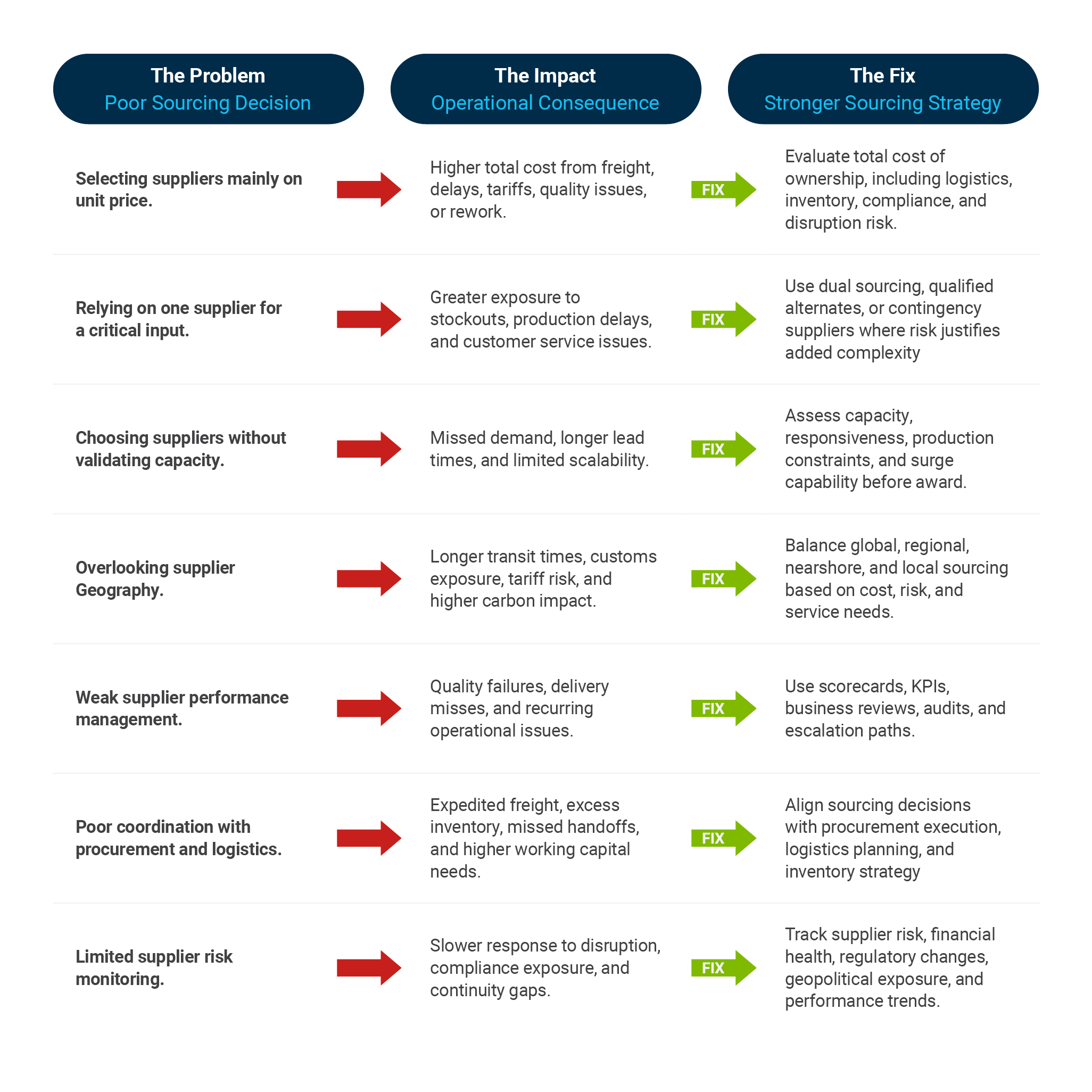
Even strong sourcing strategies face pressure from cost volatility, supplier constraints, regulatory change, logistics disruption, and shifting customer demand. The goal is not to eliminate every risk. It is to understand where exposure exists, build the right controls, and make sourcing decisions that help the business respond faster when conditions change.
Challenge: Focusing Too Much on Unit Price
The lowest bid is not always the lowest-cost option. A supplier with attractive pricing may introduce longer lead times, higher freight costs, quality issues, tariff exposure, or added inventory requirements.
Solution: To overcome this, companies should evaluate total cost of ownership and landed cost. That means considering transportation, duties, customs, storage, working capital, compliance, quality risk, and disruption costs alongside supplier price.
Challenge: Overreliance on a Single Supplier or Region
Single-source relationships can support specialization, consistency, and stronger collaboration. However, they can also leave businesses exposed if one supplier, facility, trade lane, or region becomes constrained.
Solution: Companies can reduce this risk through dual sourcing, qualified alternate suppliers, regional diversification, and contingency planning. The goal is not to add complexity everywhere, but to protect the categories where disruption would have the greatest business impact.
Challenge: Supplier Performance Variability
A supplier may meet expectations during onboarding but struggle once demand increases, specifications change, or market conditions tighten. Without clear governance, small performance issues can become recurring supply chain problems.
Solution: Companies can improve consistency by setting clear KPIs, quality standards, audit processes, escalation paths, and supplier review cadences. Supplier performance should be measured continuously, not only revisited after failures occur.
Challenge: Limited Visibility Into Supplier Risk
Supplier risk can change quickly. Financial instability, geopolitical exposure, logistics disruption, regulatory shifts, capacity constraints, and currency volatility can all affect supplier reliability.
Solution: To stay ahead, companies need ongoing risk monitoring. This may include tracking supplier financial health, regional exposure, transportation conditions, regulatory changes, and performance trends. Better visibility helps teams act before risk becomes disruption.
Challenge: Compliance and Sustainability Requirements
Sourcing decisions increasingly carry compliance and sustainability implications. Supplier selection may affect documentation, labor standards, emissions, materials traceability, product safety, and regulatory exposure.
Solution: Companies can manage this by building compliance and sustainability expectations into supplier qualification, contracts, documentation, audits, and ongoing governance. These requirements should not be treated as afterthoughts. They should be part of the sourcing decision from the start.
FAQs on Sourcing and Supply Chain Management
How often should companies review their sourcing strategy?
Companies should review their sourcing strategy at least annually, but high-risk categories may require quarterly or even continuous review. Supplier performance, cost changes, tariffs, geopolitical risk, logistics constraints, demand shifts, and new compliance requirements can all affect whether a sourcing strategy still supports the business.
Who should be involved in sourcing decisions?
Strong sourcing decisions usually require input from procurement, supply chain, operations, finance, engineering, quality, compliance, and logistics teams. This cross-functional approach helps ensure supplier decisions are evaluated not only by price, but also by quality, lead time, risk, capacity, working capital, and customer impact.
What metrics should companies use to measure sourcing performance?
Common sourcing performance metrics include total cost savings, supplier on-time delivery, quality defect rates, lead time performance, supplier risk scores, contract compliance, cost avoidance, inventory availability, and supplier responsiveness. The best metrics should connect sourcing activity to broader supply chain outcomes.
When should a company consider changing suppliers?
A company may need to change suppliers when performance issues become recurring, total cost increases, risk exposure grows, capacity no longer supports demand, quality declines, or compliance requirements are not being met. However, supplier changes should be managed carefully to avoid disruption during transition.
How can sourcing support supply chain resilience?
Sourcing supports supply chain resilience by creating more reliable supplier options, reducing overdependence on a single source, improving visibility into supplier risk, and aligning supplier strategy with logistics, inventory, and continuity planning. Resilience improves when companies evaluate suppliers based on long-term performance, not just immediate cost.
What role does technology play in sourcing and supply chain management?
Technology can improve sourcing by centralizing supplier data, tracking performance, monitoring risk, improving spend visibility, and supporting faster supplier evaluation. AI and analytics can also help identify cost patterns, risk signals, supplier alternatives, and market changes, but technology works best when paired with clear governance and sourcing expertise.
Partnering with Jabil for Sourcing and Supply Chain Management
Complexity in sourcing and supply chain management isn’t slowing down, and execution is what separates strong strategies from real results. Jabil Procurement & Supply Chain Services helps organizations operationalize change through procurement and supply chain consulting, managed services, logistics management, and market intelligence, so sourcing performance improves in a way that’s repeatable, not reactive.
Jabil is a practitioner-led operating partner built to manage high-variability, high-stakes global supply chains, helping teams move from supplier strategy to durable execution with confidence and consistency.
With 60+ years of supply chain expertise, $25B+ in annual procurement spend, 38,000+ supplier relationships, 3,000+ supply chain experts, and a global footprint spanning 100+ locations across 25+ countries, Jabil brings the scale and execution depth required to make improvements stick.